
Legislative Advocacy Advances Critical Benefits and Healthcare Reforms for Disabled Veterans
Paralyzed Veterans of America, (PVA) took center stage in December congressional hearings to advocate for legislation addressing the financial and healthcare challenges facing catastrophically disabled veterans and their families.
National Treasurer Tom Wheaton represented the organization before the House Veterans’ Affairs Committee on December 3 during examination of the Sharri Briley and Eric Edmundson Veterans Benefits Expansion Act. The proposed legislation would increase Special Monthly Compensation for the most severely disabled veterans and raise Dependency and Indemnity Compensation rates for surviving family members of deceased servicemembers and disabled veterans.
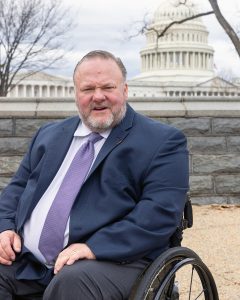
Wheaton told committee members that many catastrophically disabled veterans are experiencing significant financial strain, often spending more on daily home-based care and other disability-related needs than they receive in SMC. The baseline rates for this compensation have not been raised in years, leaving it insufficient to meet Congress’s original intent of assisting veterans with higher costs of living associated with severe disabilities.
The legislation includes provisions to increase the rates of SMC R1, R2, and T by $10,000 annually. Wheaton emphasized the growing costs that disabled veterans face, including the need to hire assistance for basic home ownership tasks and increased travel expenses related to their disabilities.
Addressing the committee about survivor benefits, Wheaton highlighted the difficulties veterans on fixed incomes face in saving resources for their families, many of whom sacrificed their own careers to provide care. The proposed legislation would increase the base amount of Dependency and Indemnity Compensation by one percent annually for five years.
Committee leadership is currently developing alternative funding solutions for the benefit increases following concerns raised during the hearing. A markup of the bill is expected in the new year.
National Legislative Director Addresses Key Claims and Healthcare Issues
On December 10, PVA National Legislative Director Morgan Brown testified before the Senate Veterans’ Affairs Committee on multiple pieces of veterans legislation. His testimony focused on three bills with significant implications for the wheelchair user and disabled veteran community.
Brown spoke in favor of the Review Every Veteran’s Claim Act, which would limit the VA’s authority to deny claims solely because a veteran missed a medical examination. He noted that thousands of veterans’ claims for service connection, increases, Total Disability Individual Unemployability, and Aid and Attendance have been denied based solely on missed examinations. PVA members face legitimate challenges in attending scheduled exams, and VA contractors have made erroneous “no show” recordings. Brown also questioned whether examinations are necessary for many veterans with spinal cord injuries and disorders who already receive care through the VA’s specialized system.
Regarding the Veterans Appeals Efficiency Act, Brown expressed support for meaningful data tracking to improve the claims process effectiveness and accuracy. However, he cautioned that data collection would prove meaningless unless the VA addresses underlying problems in obtaining proper medical opinions, which continue to result in remandable errors.
Brown also advocated for improved joint use agreements between the Department of Defense and the VA through the proposed SERVE Act. These agreements enable sharing of medical personnel, facilities, and resources, leading to faster access to quality care and improved medical outcomes while reducing federal spending. Despite decades of authority to execute such agreements, the departments have never utilized them to their full potential.
During questioning, Brown addressed the SAFE STEPS for Veterans Act, emphasizing the importance of proactive fall prevention programs. With half of the estimated 16.5 million living veterans over age 65, and considering the substantial cost of fall-related care to both the government and individuals, reorienting existing VA fall prevention programs toward a proactive approach makes fiscal and practical sense.
VA Announces Healthcare System Reorganization
VA Secretary Doug Collins announced a significant reorganization of the Veterans Health Administration on December 15. Under the new structure, VHA Central Office will focus on setting policy goals and conducting financial management, oversight, and compliance. Operations Centers and Veterans Integrated Service Networks will develop operational, quality, and performance standards to guide the VA’s more than 1,300 medical facilities.
PVA CEO Carl Blake released a statement expressing concern about administrative bloat that has hindered healthcare decision-making and made it difficult for VHA to hire necessary staff. Blake offered support for steps that will eliminate or significantly reduce unnecessary barriers, expressing hope that the reorganization will result in increased accountability and resolve ongoing clinical staffing challenges. The VA emphasized that staffing and operations at medical centers and clinics will not change as part of this reorganization.
Department of Transportation Modifies American Airlines Penalty
In a development affecting wheelchair users and mobility device users who travel by air, the Department of Transportation amended a landmark penalty against American Airlines in December. The original October 2024 order imposed a $50 million penalty for serious violations of the Air Carrier Access Act, including mishandling passengers’ wheelchairs and scooters, providing unsafe aisle chair assistance, and undignified treatment of mobility device users.
After American Airlines paid only one of three required installments, the DOT amended the order. Rather than paying the remainder of the fine, the airline must now invest the remaining funds to improve wheelchair handling. By December 2026, American Airlines must purchase 23 or more wheelchair movers, buy 119 lifts at Miami, Philadelphia, and O’Hare airports, and purchase and implement an assistive device tracking system.
PVA CEO Carl Blake emphasized in a statement that airlines must proactively invest in passenger safety before incidents occur, not as a penalty alternative.
Electronic Health Record System Faces Continued Scrutiny
The House Veterans’ Affairs Subcommittee on Technology Modernization held an oversight hearing on December 15 to evaluate the readiness of the VA’s new electronic health record system before its scheduled 2026 launch at 13 additional facilities.
Dr. Neil Evans, acting program director for the project, reported that the system has made significant progress in stability, with incident-free time exceeding Service Level Agreement requirements for 21 consecutive months. The system experienced no outages for more than 200 consecutive days at the conclusion of fiscal year 2025.
However, the Government Accountability Office released findings the same day revealing that the VA has yet to fully implement 16 of 18 recommendations previously made to address system problems. GAO Director Carol Harris expressed concern that the department does not plan to conduct a comprehensive, independent assessment before next year’s launch, warning that premature deployment poses unnecessary risks to patient health and safety.
CHAMPVA Program Improvements Show Progress
The House Veterans’ Affairs Subcommittee on Health examined the Civilian Health and Medical Program of the Department of Veterans Affairs on December 10. CHAMPVA provides comprehensive healthcare coverage for spouses, widows and widowers, and children of eligible veterans, as well as Primary Family Caregivers.
In submitted testimony, PVA noted that the VA recently eliminated a backlog of more than 70,000 CHAMPVA applications and reduced pending appeals from roughly 20,000 to about 1,000. The department now processes new applications in days rather than months and can handle more than 4,000 applications per week.
A more automated application processing system planned for implementation this month will increase efficiency and ensure most medical services and pharmacy claims are electronically processed within days for more timely payment. Timely reimbursement has been a persistent problem affecting provider participation in the program.
PVA encouraged Congress to pass the CHAMPVA Children’s Care Protection Act, which would raise CHAMPVA’s eligibility age to 26, making it consistent with all other federal and private plans and ensuring that veterans’ dependents and survivors receive support comparable to civilians.
Looking Ahead
As Congress prepares to reconvene in the new year, disability advocates and veterans organizations will continue pressing for legislative action on these critical issues. The hearings conducted in December established a foundation for continued advocacy around benefits increases, healthcare system improvements, accessibility protections, and modernization efforts that directly impact wheelchair users and severely disabled veterans.
For veterans and family members who experienced delays in Chapter 35 education benefit payments that remain unresolved, PVA encourages contacting Associate Legislative Director Julie Howell at JulieH@PVA.org.
Organizations and individuals seeking more information about these legislative initiatives can monitor the House and Senate Veterans’ Affairs Committee webpages for updates on hearings, markups, and bill progress.