
Conference session looks at adaptive driving basics
Driving a vehicle when living with a spinal cord injury or disease is an important part of rehabilitation and regaining independence. But there is a learning curve, and driver rehab specialists can make the process easier by helping patients figure out what kind of adaptive equipment they need and how to use it safely.
“The role of the driver rehab specialist and getting people back behind the wheel is to do a full assessment and really help identify what those custom solutions are going to be for that driver and get them trained so they’re confident and competent in using that and working their way through the licensing system so that they can be an independent driver,” says Association for Driver Rehabilitation Specialists (ADED) CEO Elizabeth Soles, OTR/L, CDRS, CAE. ADED is a nonprofit professional society that provides continuing education and has a credentialing program for providers in the specialized field.

Soles and Certified Driving Rehabilitation Specialist (CDRS) Megan Robbins, OTR/L presented an introduction to adaptive driving equipment and overview of how a CDRS conducts evaluations Friday during the final day of the Los Angeles Abilities International Accessibility Conference at the Long Beach Convention Center in California.
Soles says any equipment modification, from low tech to high tech, must be purchased and installed by a reputable vendor to ensure it’s safe.
To determine if someone is safe to drive, Robbins says CDRSs first conduct a clinical assessment encompassing vision, cognition and physical aspects. Vision assessment includes visual processing, and cognition involves assessing speed of processing, ability to multitask and task shifting. Specialists also look in depth at the person’s medical history, diagnoses, driving history and medications and their side effects.
“The more insight a patient has into their own deficits, how they feel and what their symptoms are, the better,” Robbins says.
In addition, patients must fill out a questionnaire before meeting with a CDRS to help determine if they’re at their highest level of independence in the home and the community before being permitted to drive.
If patients passes the clinical assessment, they are ready for the behind-the-wheel assessment, which is conducted in a real training car on real roads, with the CDRS having access to a separate set of brake and gas pedals.
“We’re looking at devices,” Robbins says. “If you’re in a wheelchair, can you break that thing down and get it into the back? You know, can you not just put it in the car, but can you also kind of tie it down and secure it?”
Other focus areas include getting in and out of the car, seat positioning, vehicle control, traffic management and an introduction to any adaptive equipment.
Robbins says anyone who requires adaptive equipment must go through training. Following training, depending on the licensing state, a driver either has the equipment installed on his or her own vehicle before taking the driving test or uses the trainer’s car.
When it comes to adaptations, depending on the vehicle, Robbins says many options are available for transfer assistance, seating, mobility device stowage, steering devices, hand controls and pedal extensions. Vendors can help assess whether a certain product will work for a particular vehicle, and Robbins says the simplest solution that’s appropriate for the patient is often the best.
Some vehicles can be outfitted with a ramp that goes inside with a wheelchair or specialized seating that allows the driver to transfer from a wheelchair to the driver’s seat.
Once inside the vehicle, some drivers may need a chest strap for balance or custom cushions.
“So, I’m going to ask if there’s something better for my patient,” Robbins says. “That’s why I’m talking to my [physical therapists] PTs, right? I’m talking to the vendors. So, this is not just a one decision from any one person. We really are talking a lot to the people in our team.”
Robbins also notes that wheelchair securement is crucial and must follow safety regulations.
If a mobility device is stowed in a trunk, specialists must verify that the driver can walk 10 to 20 feet and has balance, while also factoring in possible fatigue or unfavorable weather conditions. There are lift systems that pick up the mobility device and deposit in the vehicle, but the patient must have the dexterity to connect the system to the device and push a button.
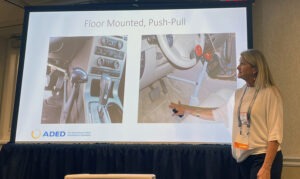
Robbins says hand controls options include mechanical, with rods that go to the accelerator and brake, and electronic, where electronic signals are connected to the accelerator. She says electronic controls allow more knee space, and some people believe they’re more performance-driven. Other people prefer the mechanical controls because they cause fewer problems. Another option is an accelerator ring that’s mounted above or below the original steering wheel, with a main brake lever mounted on the side.
There are also spinner knob options for steering, depending on the driver’s hand dexterity and strength. Robbins says although the spinner knob seems basic, it also requires training.
“It’s not a right to drive. It is a privilege,” Robbins says. “We have to have the skills.”