

45th NVWG Kicks Off in Detroit
Detroit showed up with some classic cars, revved-up sports celebrities and added in some Motown soul as it opened up the first day of the 45th National Veterans Wheelchair Games (NVWG) on Thursday.
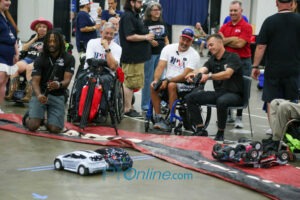
Outside the 2.4-million-square foot Huntington Place convention center, some classic cars lined the street for the more than 500 wheelchair athletes to check out. Meanwhile, a handful of adaptive sports, including the inaugural adaptive RC car racing exhibition, kicked off the competition part of this year’s Games, which are cosponsored by the Department of Veterans Affairs (VA) and Paralyzed Veterans of America (PVA).
Even IndyCar Team Penske driver Scott McLaughlin and NASCAR play-by-play and IndyCar pit reporter Jamie Little zoomed in to try out a few sports and talk to athletes.
When the NVWG started in 1981, it totaled just 77 athletes in seven events. Now, it regularly includes over 500 athletes and features more than 20 adaptive sports. PVA National President Robert Thomas Jr., says these Games have shown what’s possible when disabled veterans are met with opportunity and choose to support it — rather than bury it. It has changed lives, including his, and during the opening ceremony, he wanted veterans to remember what adaptive sports and the Games can do.
“Today, 45 years later, this event has grown into the world's largest annual adaptive sports and rehabilitation event designed exclusively for veterans with a disability,” says Thomas, a Navy veteran who is serving in his fourth year as the organization’s national president. “As I look out on more than 500 athletes here this evening, I am filled with pride. You are the heart of this event. You continue to embody resilience and determination. The National Veterans Wheelchair Games have brought together thousands of veterans across all service branches and areas,
giving them the chance to find their footing, rediscover their strength and reclaim their independence.”
It’s already helped veterans like Alexis Duran. The 42-year-old Tampa, Fla., resident and Army veteran captured the inaugural adaptive remote control (RC) car racing exhibition title — despite never having done it before and competing in his first Games.
Fifty athletes used an adaptive remote control with throttle and brake toggle and a small steering wheel to control their miniature cars inside a small race track with an inflatable barrier around it. The event started with 10 heats of five athletes going against each other and each heat winner moving on to the semifinals. Each athlete had three minutes to follow arrows around the track and complete as many laps as he or she could, trying to avoid hitting other cars or going off course.
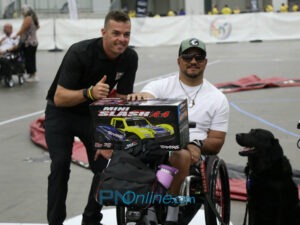
Duran finished as one of the 10 heat winners, then won one of the three semifinal heats and finished by recording the most laps in a three-person championship final. Each of the championship qualifiers received a pre-built RC car to take home. He was thrilled.
“This is the first thing I won in years,” says Duran, who has a level T6 complete spinal cord injury and who is one of 150 novices registered to compete in this year’s Games. “So, it’s more than a car for me. It’s gonna be more than a car.”
McLaughlin tried out RC car racing, too. He outdueled PVA Mid-Atlantic Chapter member Lee Sexton, and they shared some laughs in a one-on-one three-minute exhibition heat.
Born in New Zealand, the 33-year-old and seven-time NTT IndyCar series race-winner
McLaughlin admittedly had some previous experience, though. He said he used to do RC car racing with an off-road dirt buggy in Brisbane, Australia, about 15 years ago when he was a kid. McLaughlin and Little also tried wheelchair basketball and even wheelchair softball with Sexton later. McLaughlin says he had an awesome time at his first NVWG.
“I think it’s not only just celebrating good competitive spirits and sport, but like, to see veterans, you know, that have maybe had a setback in their life or something like that still, you know, see them find their competitive juices another way because they’re amazing, amazing people and have given up a lot for our country,” McLaughlin says. “And it’s just cool to see them get rewarded in some ways for, you know, ultimately a setback they took for everyone else, you know. And that’s what’s really cool about this event — it’s like seeing the smiles on everyone’s faces and a community that’s built, you know, which is really cool.”
Interim Medical Center Director of Detroit Department of Veterans Affairs (VA) Healthcare System Michelle Martin says Detroit is the right city to host this year’s NVWG, as she acknowledged it knows how to meet challenges head on, knows how to rebuild and knows how to keep moving. But she also says the Games give the Detroit VA Medical Center a chance to show what veteran-centered care looks like outside of the walls of a VA medical center.
“Our purpose is not only to treat injury and illnesses. Our purpose is to help veterans build the kind of life they want to live. These Games bring that purpose to life. Adaptive sports are a powerful part of that work. They help veterans grow, build strength and endurance. They also create goals, restore confidence and build friendships. They give veterans a place to test themselves and to encourage others. A competition can become a turning point. A teammate can become a friend. A week like this can remind someone that their story is still being written. These Games also remind us, all of us in the VA, why our work matters. A clinic visit may be just the beginning. A therapy session, a prosthetics fitting or a recreation referral may be the next step. A conversation with a nurse, a social worker or a fellow veteran may be the moment that helps someone keep on going.”