
The busy holiday travel season is in full swing, and while flying is usually the easiest way to cover long distances, wheelchair users know it’s anything but easy for them. A pair of events involving Paralyzed Veterans of America (PVA) are working on two fronts to help those travelers.
The All Wheels Up (AWU) Global Forum and Access to the Skies Summit are events focused on improving the flying experience for those with spinal cord injury and disease and other disabilities. While they share the same goal, each event does so by engaging with distinct groups who look at the process from different angles.
AWU founder and President Michele Erwin describes that forum as a gathering of stakeholders looking at making flying accessible “through the lens of business and actual data.” She says Access to the Skies takes AWU “and puts it through the lens of the community.”

Held back-to-back Sept. 28–Oct. 1 in Colorado Springs, Colo., each event attracts an impressive list of worldwide officials from airlines, airports, aircraft manufacturers and governments, as well as leaders from PVA, travel influencers, advocacy groups and others. Working side by side allows both events to cover more ground — and air — by bringing people together in a unified effort to make flying safer, easier and more dignified for all travelers with disabilities.
“It’s literally gonna take the world and every organization to make this happen. It’s gonna definitely be a collaborative effort,” Erwin says. “And part of that collaborative effort is not just the industry that’s in that room, but also the community that needs to show up and engage.”
Curb-To-Plane
That collaborative effort began with the AWU Global Forum Sept. 28–29 at the Hotel Polaris, situated just outside of the north entrance of the United States Air Force Academy.
Now in its seventh year, the forum is presented by AWU, which was founded by Erwin in 2011 after she experienced problems traveling with her son, Greyson, who has spinal muscular atrophy. The nonprofit organization advocates for accessible commercial air travel and pioneers research for securing wheelchairs in airplane cabins. The forum is where the infrastructure of wheelchair-accessible flight, airplane cabin layouts, transportation in the airport, regulations, innovations and more are discussed.
This year’s forum, sponsored by PVA, featured more than a dozen sessions over two jam-packed days that included roundtable discussions, breakout groups and product exhibitors. The wide range of topics covered included government policy, research from the Federal Aviation Administration, airport accessibility, the economics of placing a wheelchair in a plane cabin and others.
Amid the varied topics, one central focus that resonated the most with forum attendees was the idea of creating a better, seamless curb-to-plane experience for travelers with disabilities, especially for those who use wheelchairs. While that transition covers a lot of areas, PVA National Treasurer Tom Wheaton says the safety of the traveler and his or her equipment is what makes that a top priority for him.
“I’m discouraged to know so many of my peers forgo air travel for that reason,” says Wheaton, a Navy veteran with a spinal cord injury who has been traveling in a wheelchair for 38 years. “But when our bodies get damaged, it can result in broken bones or pressure sores that actually can result in death if it’s not handled correctly. That has to start at the airplane level with the training to make sure that people are equipped and consider it when trying to transport us.”
Two chief concerns with delivering a better curb-to-plane experience voiced during the forum were the seeming disconnect with the various providers involved with transport and holding those groups accountable.
William Neece, CEO of Ozion Americas, a division of Ozion Airport Software, noted the huge level of anxiety among passengers being transferred and asked why one airport may have multiple transfers for a passenger, yet another one comes out to the curb to meet him or her.
“The passenger experience is horrible because there’s no connectivity,” says Neece, whose company provides specialized service intelligence and an operations platform designed for aviation, ground handling and airport security.
He believes understanding the passenger journey is key, and there could be quick improvements simply by “plugging in and analyzing” how operations work now. However, even with improvements in the passenger journey, there’s still the matter of accountability.
PVA Chief Policy Officer Heather Ansley, Esq., MSW, says that while the “holy grail” of letting passengers fly in their own wheelchairs is what many people are trying to get to, we must ask, “What can we do on the way there?” Ansley believes enforcing the requirements that already exist is one way to make the process better now while still moving forward.
“Too many people’s safety is still being endangered,” she says. “We wouldn’t tolerate if every day a person was being injured, not because of turbulence, but just getting on and off the plane. We’d say, ‘We have to fix this.’ Yet, for people with disabilities, it’s the status quo.”
Assert Your Rights
Fixing that status quo doesn’t just require looking at air travel for people with disabilities through the aforementioned “lens of business and actual data.” It needs help from those doing the actual flying, and that’s where the Access to the Skies Summit took off Oct. 1.
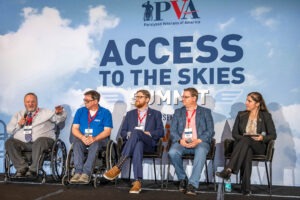
Presented by PVA also at Hotel Polaris, Access to the Skies featured multiple panel discussions that included updates on the Air Carrier Access Act (ACAA) from the U.S. Department of Transportation, how to prepare to fly, how to handle problems and more.
One of this event’s main goals is sharing input from those flying with a disability with the people who are doing the work involved with accessible air travel. Ansley says this is a way to change the thinking of what she calls “workarounds” to provide access for passengers with disabilities.
“We haven’t changed the aircraft, so we require wheelchair users to use aisle chairs that fit the aircraft and not the user,” she says. “The system is still fundamentally inaccessible. People with disabilities are basically being treated as square pegs, and we’re trying to stick them in a round hole and then wondering why things go south.”
One main emphasis during the Access to the Skies Summit was that travelers should know their rights before “things go south,” and if things do go wrong, they should know how to file a proper complaint. During the How Should You Prepare For Your Air Travel Journey panel discussion, Incredible Memories Travel owner Kristy Durso stressed the importance of knowing the ACAA Bill of Rights (www.transportation.gov/airconsumer/
disabilitybillofrights) because her wheelchair has been damaged 17 times in three years, and she’s “gone toe-to-toe” with multiple airline crews who don’t know it.
“Be comfortable asserting the rights that are granted to you to protect yourself and protect your equipment so that you have a safe experience,” says Durso, who is an Army veteran and full-time wheelchair user with two autoimmune diseases.
Wheaton also has had a fair share of trouble over his almost four decades of flying and believes travelers should act quickly when something has gone wrong. During the How Should You Handle a Problem During Your Trip panel, he says when you hit that “boiling point” with a problem and don’t complain right away, sometimes you “simmer down,” more time goes by and nothing happens. He says whether there’s an issue with potential damage to your body or wheelchair, if there are problems really “digging into these violations of the [ACAA] Bill of Rights,” it’s important for everyone to act.
“We want to make sure that we capture all these complaints and not only to do it individually, but also to make sure that we have an advocacy group like PVA who actually will grab all of the information from around the country from all these complaints and then glean from those what are these top themes we’re seeing,” he says. “It takes all of us to actually do the work to make sure we are firing appropriately and timely.”
The Future
With everyone from the travelers to the airlines, airports and others doing “the work,” the obvious question is what the future looks like for accessible air travel. The answer depends on how far in the future you want to look.
The immediate future is focused on several fronts, including improved training and connectivity among service providers to deliver that seamless curb-to-plane experience, protecting travelers’ equipment, travelers knowing their rights and enforcing accountability among the service providers.
Further out, one of the biggest and most anticipated changes to the ACAA takes place in 2035 when new, single-aisle aircraft must have two-person accessible lavatories. Other improvements on the horizon include aircraft manufacturers working on wheelchair ramps for the gate and airlines allowing wheelchair users to tell them what type of chair they use when booking their flight.
While those changes are some ways away, Erwin believes it’s important for events such as All Wheels Up and the Access to the Skies Summit to let travelers with disabilities know work is being done to help. Wheaton points to PVA’s historical advocacy to help get the ACAA passed 40 years ago as an example of how it can take time to get that work done.
“It’s definitely encouraging that we have these brilliant minds come together to share possible solutions. And at the same time, tempering that with the long trench of time it takes to effectuate change,” he says. “It’s not something that’s going to happen three months from now. More like 12 years from now. That’s sometimes a tough pill to swallow, but these types of events are catalysts for us to really improve and press along.”
For more information on All Wheels Up or the Access to the Skies Summit,
visit allwheelsup.org.
For more on this topic, please read our accompanying “Flying Innovations” story here.