
Resources can help families affected by SCI/D, MS and ALS
Many veterans and others with spinal cord injury and diseases (SCI/Ds) like multiple sclerosis (MS) and amyotrophic lateral sclerosis (ALS) rely on caregivers to perform activities of daily living and maintain their independence. Often, these caregivers are family members — and sometimes they are children, youth or young adults.
Melinda Kavanaugh, PhD, LSCW, a social work professor with the Helen Bader School of Social Welfare at the University of Wisconsin-Milwaukee and president of Global Neuro YCare, spoke about these “hidden helpers” and the challenges they face in finding support and resources during a session on Tuesday’s second full day of the 2026 Paralyzed Veterans of America Healthcare Summit + Expo at the Horseshoe Las Vegas in Nevada.
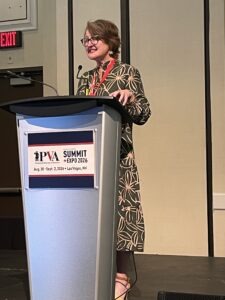
She says there are an estimated 5 million young carers ranging in age from 6 to 25 in the U.S., with about 3 million in veterans’ homes. Between 5% to 22% of college students are currently or were caregivers.
Studies in civilian, military-connected and veteran populations show the most common care recipients were grandparents, as well as parents and siblings, but it varied by illness. Care tasks included transferring, bathing, dressing, feeding and medication management, as well as assisting with communication and assistive devices.
“Anything that an adult does, there is a child or youth somewhere participating in that level of care,” Kavanaugh says.
According to studies, time spent on caregiving tasks varied by the care recipient’s illness, the caregiver’s age and existence of other caregivers in the home, but it ranged from several hours a week to several hours a day.
“Youth are getting up in the morning and providing care, coming home from school, providing care into the afternoon and evening, overnight providing care,” Kavanaugh says. “So, that’s a real key takeaway for us to consider and us to remember when we’re talking about caregiving, when we’re talking about programs, when we’re talking about resources. Those children and youth exist, and they’re providing often tremendous amounts of care.”
Kavanaugh’s recent research focuses on young caregivers and sleep. Her early data suggests that children who are caregivers have more disruptive sleep compared to their normative peers.
“They’re not sleeping as consistently, and they’re not sleeping as deeply. What we also know is that when they don’t feel they have enough support, when they don’t feel they have enough resources or respite, that’s when we start seeing higher levels of mental health issues, higher levels of depression and worry and concern,” Kavanaugh says. “It’s not rocket science. It’s the same thing in the adult population. When we support them, when we provide respite and when we provide resources, those negative indicators decline.”
She says when children live with the care recipient or have a greater number of caregiving duties, there’s also a higher risk of anxiety and depression. Caregiving can also impact school performance and attendance, as well as social interactions with peers. Kavanaugh says these areas could be improved with more resources and supports.
“They’re going to school late. They’re leaving school early. They might not be able to commit to completing all their schoolwork, their homework,” she says. “But we also know that they’re falling asleep in class, and they’re also deeply, deeply worried throughout the day.”
In addition, she says military-connected and veteran young carers report that they are always on high alert when out in the community with their family member.
“Is there going to be some sort of trigger that they need to pay attention to? Do they need to make sure that the environment is somehow safe somehow?” Kavanaugh says. “They’re an arm’s length away. Like, how do we need to be thinking about this versus just care in the home? So, there’s a lot of things that go into the things that children and youth think about when they’re out and about or when they’re home and as it relates to care.”
However, young carers are also acutely aware of the positive aspects of caregiving.
“They want to do things to help, and they want to understand what’s going on in this illness and injury, because then they feel more connected and it seeps in and makes them feel better all the way around about the experience,” Kavanaugh says.
To help create more resources for young carers, Kavanaugh and her team decided to develop a superhero-themed activity guide that gives prompts and allows children to draw, write or use stickers to identify their superhero skills and share how they use those skills to help their family member.
“It really helps them feel confident in what they’re doing, but also express how they feel about it and also express that they maybe don’t have other ways to talk about it or engage with it,” she says.
They also created a journey map for teenagers that allows them to share their caregiver experience and gives them QR codes for videos to learn from other teens who are going through a similar journey.
“So, these are opportunities for our youth to be able to share their own journey and be and do it in a way that is either writing it or stickers or color, whatever it is that they want to do,” Kavanaugh says. “The whole goal behind these programs is to find out what strengths can they draw upon themselves? Who are they as individuals? And then what does that future look like for them?”
Based on Kavanaugh’s research, they also developed one-page guides on different topics that cover any injury or illness, as well as specific resources for families and kids to discuss topics related to SCI/D, MS and ALS.
In addition, Kavanaugh wrote a graphic novel called Real Kids Talk About ALS: Feeling Normal, Sad, and Different that explains what ALS is, how to talk to friends, what is caregiving and what is death and dying. She was also involved in an animated short film called Luki & the Lights, which tells the story of a robot that is diagnosed with ALS. As the robot’s disease progresses, his lights go out. A companion family guide and coloring book allow kids to go through the film scene by scene and answer questions.
Another resource she helped start about 10 years ago is the YCare program (globalneuroycare.org/ycare-program), which gives kids the opportunity to walk through SCI, MS or ALS caregiving situations and ask questions with their peers under the guidance of trained health care professionals. The one-day program is offered nationally.
“We’re really hoping to be able to adapt it very specifically into the veterans community in ALS, really integrating the combination between military service and veterans’ experience in ALS,” Kavanaugh says.
Her main goal is to let people know that children and youth are providing care to veterans and others with disabilities, and there are resources for them.
“And as long as we can kind of continue partnering and continue making as many resources and supports as possible, then I think my work here is done,” Kavanaugh says.