

VA secretary, substance use treatment accessibility highlight Day 1 of PVA Healthcare Summit + Expo
by John Groth and Brittany Martin
The Department of Veterans Affairs (VA) is finally changing — and that’s exactly what VA Secretary Doug Collins wants. There’s slowly going to be less mess. He’s made some major headway already.
During Monday’s opening keynote address during the Paralyzed Veterans of America (PVA) Health Summit + Expo’s opening day at the Horseshoe Las Vegas hotel in Nevada, he shared what’s changed and how PVA has helped, as well.
Collins shared that when he took over as VA secretary in 2025, he asked VA leadership how many employees the organization had, and that it took them a week and a half to give him an answer. Another month later, he says he found out they had 60 facilities that were still doing their own payroll that wasn’t centralized like it was supposed to have been four years earlier.
He says those two issues have been fixed. Additionally, they didn’t have staffing documents that tell where people are and what they do in each hospital. Now, though, they finally do.
“You can’t be the largest integrated health care system in the country and not act like it,” Collins says. “So, I said, ‘Here’s what we’re going to do. We’re going to start acting like it.’”
As a now-retired Air Force Reserve and Navy veteran himself, Collins considers it immensely important to serve what he calls the greatest population in the world.

His plan — to do everything he can to make the VA, the largest integrated health care system in the world, to be the absolute best.
They’ve also implemented the Veterans Health Administration Resource for Impact and Sustainability Effort (RISE), which is changing the VA structure and reorganizing it into three separate but interconnected levels, including the VHA Central Office (which sets policy and governs the entire system), operations centers and VISNs (which provide oversight, direction and support for implementation) and 139 health care systems that deliver care and services to veterans.
That’s also why he’s worked at updating the VA’s electronic health records management system, he told the more than 500 clinicians, physicians and others in attendance.
“How does that affect you? It means you have better technology. You have better communication with your community, and you have better communication with your patients and other facilities,” says Collins, who just retired from the Air Force Reserves in May after serving as a chaplain for nearly 25 years. “We’re the only ones in the world right now that have a system in which I spend $700 million a year just to keep it alive. Not to make it better, to keep it alive. So, that’s why we have to start moving our infrastructure.”
It’s the second straight year Collins delivered the PVA Healthcare Summit + Expo’s opening keynote address.
He also mentioned PVA as being a catalyst in helping the veterans’ cause.
“My goal is that in the next few years, when the VA walks into hiring fairs, the other hospitals are going to say, ‘Oh God, here comes the VA. They’re going to take our doctors and nurses because people want to work there.’” Collins says. “The nation is living up to its promise of taking care of its veterans. You know why that’s going to happen? Because of organizations like PVA, who are singularly focused on taking care of those in their charge. But it’s going to happen because VA employees are the absolute best at what they do, and it’s my job to turn you loose.”
Accessing Substance Use Treatment
Health care providers and clinicians are also important when it comes to keeping veterans and others with spinal cord injury and disease (SCI/D) healthy, including ensuring they receive treatment for substance use or abuse.
Many people struggle with substance use and abuse, and fortunately, there are treatment centers that can help people get sober.
However, a recent audit study conducted by Kaiser Permanente Institute for Health Research in Colorado found people with disabilities encounter barriers when trying to access that care.
Jo Ann Shoup, PhD, LSW, NCC, a senior research project manager at Kaiser Permanente Colorado Institute for Health Research, gave an overview of the study later Monday morning.
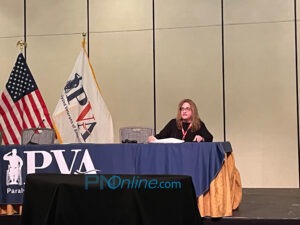
Shoup says studies have found nearly 25% of people with spinal cord injury reported nonprescription use of a psychoactive substance within the past three months, including 58.8% using alcohol, 26.6% using cannabis and 22.7% using tobacco, and 49.6% of those who’d been discharged from physical rehabilitation for a year or more reported opioid use.
In addition, compared to the general population, people with SCI have been found to have a higher risk for substance use disorders, or recurrent, uncontrollable use of substances despite the negative impact on health, well-being and social functioning. Shoup says there are several reasons.
“There’s high higher levels of chronic pain. There’s the stressors of living a spinal cord injury life. These include having increased depression and anxiety, decreased social integration,” she says. “The dual stigma of disability and substance use — that can be overwhelming. Exposure to pain medications. Past history of substance use prior to your spinal cord injury, and barriers to health care prevention and treatment.”
Shoup says there is limited literature about accessibility of substance use services. That’s why her research team recently conducted the Audit of Care and Clinic Entry for Substance Use Services (ACCESS) study, which used “secret shoppers” to assess the real-world accessibility of residential (inpatient) addiction treatment facilities in the U.S. that would admit a patient with SCI.
They focused on facilities that met specific criteria in Arizona, California, Colorado, Idaho, Montana, Nevada, New Mexico, Oregon, Utah, Washington and Wyoming. Four post-graduate trainees/medical students were given standard scripts and called each facility three times, posing as a family member seeking care for a loved one with SCI who uses a wheelchair.
“It’s an unorthodox approach to study inequities in health care delivery,” Shoup says. “It provides insights into the challenges of access to health care that might be difficult to measure through more standard investigative techniques, such as a survey where people would have a chance to think about their responses or frame them differently.”
The data was collected between August 2025 and January 2026. Overall, 348 facilities were included in the study. Of those, 250 were contacted and 98 couldn’t be reached, while 195 were urban and 55 were non-urban.
Only 110 facilities (44%) indicated they would accept the patient with SCI. Shoup says this is far lower than the general population, which has an acceptance rate between 80% and 90% and are typically denied because of insurance rather than accessibility. Of those 110 facilities that accepted admission, 93% reported all areas were wheelchair accessible, 87% had accessible bathrooms, 80% provided general support, such as carrying food trays, 64% could provide SCI-specific medical support, 63% of multi-level facilities had elevators and 55% of programs with off-campus activities provided accessible transportation.
Although the study had some limitations, Shoup says the study fills data gaps in the literature of substance use disorder treatment access for individuals with SCI.
“Increased rates of substance use disorders in people with spinal cord injury would imply that increased accessibility of substance use treatment. However, our study demonstrates that less than half were accepted into residential treatment programs,” she says. “Even with strong policy protections of accessibility through the Americans with Disabilities Act, among treatment facilities who denied access, 72% reported lack of wheelchair access. Inadequate treatment access exacerbates the existing disparities in health care for individuals with spinal cord injury, and treatment gaps have serious clinical consequences, as untreated substance use may exacerbate existing physical and psychological conditions and may heighten the risk for hospitalization in the spinal cord injury population.”