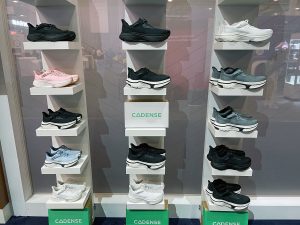

Cadense shoes offer gait help for people with MS
A major consumer technology trade show might be the last place you’d look for shoes designed for people with disabilities. But this week at CES in Las Vegas, a company called Cadense is showcasing its stylish adaptive footwear that can help people with multiple sclerosis (MS), foot drop, neuropathy and other impairments to walk with more confidence and less fear of falling.
The patented, clinically-validated technology built into the shoe includes two low-friction nylon plates on the front sides of the sole that allow the toe to glide over the ground as the person swings his or her leg forward, with high-friction rubber tread in between that grips the ground and provides traction when the person’s weight is applied.
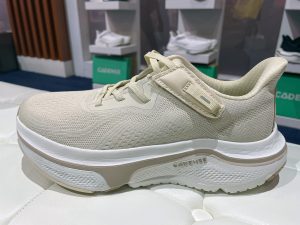
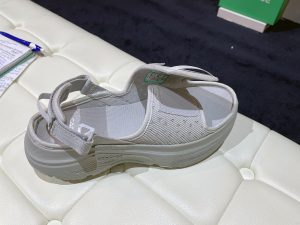
In addition, while it looks like a traditional lace-up sneaker, it is secured with a Velcro tab and has a reinforced heel that makes it easier to slip on and off. The company also offers an adaptive sandal-slide with a removable back strap and Velcro top, as well as a fur-lined adaptive slipper, each with the same friction features on the soles.
“The function of our shoe is key to success, but the looks of it makes people actually want to buy and wear the sneaker,” says Cadense CEO and co-founder Johannes Sauer. “Anything that looks good, people will use it more, and that was key to when I joined the company. I wanted to make people also feel good about what it is we do in terms of function, because there’s no need to design something that looks medical at all just to help people.”
Sauer says co-founder and Chief Technology Officer Tyler Susko’s work with robotics in gait training rehabilitation inspired him to build an affordable solution that people could use at home. Susko, who holds a PhD from the Massachusetts Institute of Technology, originally used robots to help stroke patients.
“The problem with robotics specifically in footwear is it’s heavy, it can’t get wet, it needs to be charged, and then it becomes impractical,” Sauer says. “We wanted to create something that’s practical, that looks nice, it’s financially obtainable … it took quite a while to iterate on the functionality, the shape, the geometry of the components.”
The shoes hit the market in 2023. They are now a registered Class 1 medical device in the U.S. and can be purchased with flexible spending account or health savings account funds. Sauer says the company is working on getting insurance companies to cover the cost.
Sauer says customers who wear orthoses can wear them along with the shoes, as long as their orthoses fit in their regular or wide-width shoes.
“It’s actually a great combination,” he says. “You have that additional lift and clearance from our shoes and it makes it better. We’ve heard customers say, ‘I don’t have to wear my AFO [ankle-knee orthosis] anymore,’ and that warms my heart because that means that they exercise more. The downside of the AFO is it fixates your ankle, and that results in muscle atrophy. Our sneakers help you to gain muscle because you have to use those muscles that the AFO prevents you from using.”
A four-year clinical trial with stroke patients is currently underway at Shirley Ryan AbilityLab in Chicago, and Sauer says a clinical trial involving patients with MS will be conducted in the near future to collect data and examine if their shoe solution can reduce the propensity of trips and falls in that population.
The shoes are available at cadense.com for $199, and the site provides a discount for veterans through govx.com. They’re available in a range of colors and men’s and women’s sizes in both regular and wide widths. The company offers a 30-day money back guarantee if the shoes aren’t the correct fit or don’t work well for the customer’s disability.