

Imagine that everything you owned had to fit into a single suitcase.
No storage unit. No garage. No closets filled with things you might need someday. Every possession would have to answer one question: Is it worth carrying across an ocean? Most of us will never have to answer that question. But our ancestors did.
Whether your family arrived on the Mayflower or generations later through Ellis Island, every item had to earn its place. Clothing. Money. A family Bible. Maybe a photograph or a piece of jewelry. Everything else stayed behind. That kind of decision changes your definition of value. My parents faced a version of that question about 10 years ago.
My brother, sister and I had all settled in Southern California. We grew up in Philadelphia, but none of us planned to return. Eventually, my parents accepted that we weren’t coming back and decided to make the move themselves.
After more than 50 years in Philadelphia, they retired in California. They sold furniture, gave away belongings and sorted through a lifetime of possessions, including family treasures passed down through generations. They couldn’t take everything, so they took what mattered most.
Ten years later, after they were gone, my siblings and I stood in that California home facing the same decision.
Only this time, we were sorting through everything they had already decided was worth keeping. And somehow, it was still too much. We each chose a few keepsakes, and everything else would be sold.
That sounded simple. It wasn’t.
There was the formal china that couldn’t go in the dishwasher, the grandfather clock that needed winding, the roll-top desk that wasn’t exactly designed for a modern home office. Beautiful things. They just no longer fit the way we live.
Then there was the old wooden commode that belonged to my great-great-great-grandparents.
Not the kind you see at a garage sale after grandma’s house is cleaned out. This one was handmade nearly two centuries ago on a Pennsylvania farm, long before indoor plumbing. Someone decided there had to be a better solution than walking through the snow to the outhouse on cold winter nights.
It was a ceramic pot tucked inside a beautifully crafted wooden cabinet, with a drawer for the essentials: dried corncobs, old newspaper and other forms of “bum fodder.”
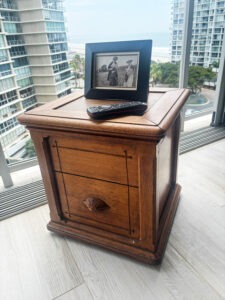
By the time I came along, it sat in my parents’ den and mostly served as the setup for my dad’s bathroom jokes. With a lamp on top, though, it looked surprisingly dignified. Somewhere along the way, it had gone from a place to sit, to a place to sit next to.
I tried to picture it in my living room. My wife leaned over and whispered, “Don’t you dare bring that thing into our house.” She saw an old toilet. I saw a family heirloom.
Fair enough.
Fortunately, my sister wanted it. Once I knew it would stay in the family, I could let it go. And that taught me something: I don’t have to own every family treasure. What matters isn’t where an heirloom ends up. What matters is that someone who loves the family becomes the item’s next caretaker.
Today, that old commode sits in my sister’s California condo overlooking the Pacific Ocean. On top are a television remote and a framed photograph of the relatives who once literally sat on it.
Funny how something that began as a practical solution became a piece of family history. That experience reminded me of a story a friend once told me about the hardest trip he ever made. His father had died, and he flew across the country to empty the family home in New York before it was sold.
He arrived one day late, and his brother and sister had already cleaned out much of the house. Five trunks filled with his father’s and grandfather’s belongings had been thrown away, including military maps, uniforms, medals and keepsakes that had survived two world wars but didn’t survive one weekend of cleaning out a house. Years later, he was still holding onto several plastic bins of what he called “sentimental stuff.”
“I guess I still feel connected to them through these things,” he told me.
Then, he described an old Zenith console that had stood in the family living room for decades. Behind one mahogany door was the television where they watched Sunday night shows together and the funeral of former U.S. President John F. Kennedy. Behind the other were the record player and radio. It wasn’t just furniture. It was where family happened. When his brother rolled it toward the dumpster, my friend reached inside and pulled out a couple of vacuum tubes. Not because they were valuable, but because they had been part of that console.
Then, it started to rain. He watched the water pour onto the mahogany cabinet.
“I cried,” he said. “We spent so many family hours around that old console.”
That’s when I realized something else. Families don’t usually fight over the most valuable things. They fight over the things that carry the strongest memories. Dad’s fishing rod, mom’s mixing bowl or even a 175-year-old toilet.
They aren’t really arguing over objects. They’re deciding who becomes the keeper of the stories.
Sometimes the greatest gift isn’t owning the family treasure yourself. It’s knowing someone you love is still carrying the story. Maybe our ancestors understood something we’ve forgotten. When everything you own has to fit into one suitcase, you’re forced to decide what matters most. Eventually, every generation faces the same question: If everything you owned had to fit into one suitcase, what would make the trip?
It probably wouldn’t be the most expensive thing you own. It would be the thing that tells your story.
Because in the end, we don’t really pass down possessions. We pass down stories.
The possessions are simply reminders of the people who came before us.
As always, please share your thoughts with me at al@pvamag.com.