

Maddox, Weaver win inaugural NVWG pickleball up/down tourney
By John Groth and Brittany Martin
Inaugural pickleball championships are becoming Lisa Maddox’s jam.
She captured her second National Veterans Wheelchair Games (NVWG) title in three years — this time with Monday afternoon’s Titan Tournament hybrid up/down championship inside the Huntington Place convention center at the 45th NVWG in Detroit. And even better, she did it with a NVWG volunteer and Marine Corps veteran Tony Weaver.
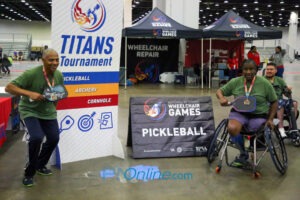
“It’s fun, but it’s really cool to win this because it’s a special effort to have a hybrid tournament. And so, to be able to play in the hybrid tournament and win it with another veteran, that’s awesome. That is so awesome,” says the 59-year-old Maddox, an Army veteran who is a left above-the-knee amputee and has cervical spinal myelopathy, which is a compression of the spinal cord in the neck. “It means a whole lot because he gave up his time to come help us. And then he helped me win hybrid.”
Maddox and Weaver teamed up to defeat Austin Parker and Rachel Parker, 11-7, in the championship match at the Games, cosponsored by Paralyzed Veterans of America (PVA) and the Department of Veterans Affairs (VA). The hybrid doubles tournament consisted of 16 two-person teams — one able-bodied player and one wheelchair player — grouped together in a bracket format. Games went to 11 points, and players reffed themselves. Standard hybrid doubles pickleball rules applied, with wheelchair players getting to return the ball back on two bounces, while able-bodied players could only hit it back on one.
A PVA Southeastern Chapter member, Maddox won the 2023 NVWG inaugural wheelchair doubles pickleball championship with partner Eric Turman in Portland, Ore.
Maddox served from 1989 to 1991 in military intelligence and 1997 to 2004 as an Army doctor. The Grovetown, Ga., resident, lucked out with her partner in Weaver, a Detroit resident who decided months ago to volunteer at the NVWG and then noticed Maddox and other wheelchair athletes needed help warming up for their regular wheelchair doubles pickleball matches on Friday. Over the weekend, Maddox asked Weaver if he’d team up with her for the event.
Weaver had just earned bronze in the 2.5 classification division at the June 27-July 2 National Veterans Golden Age Games in Tampa, Fla. The 68-year-old served from 1997 to 2004 as a telecommunications chief and then as a logistics officer. He’d also played hybrid wheelchair doubles pickleball before in Detroit.
“Marine Corps volunteers has helped us at our Golden Age game in Tampa two weeks ago. So, I wanted to return it,” Weaver says.
It was a close match. Tied at 7-7, Maddox and Weaver scored the final four points to take the title.
“So, what we did is we hit the ball to Austin because, Rachel, if you put anything in her strike zone, she was slamming it,” Maddox says. “ … Because he has good strokes, but he can’t slam like she does. And I’m like, because if you mishit a ball to her and you accidentally get it too high, you gonna eat it.”
Cornhole Titans
The inaugural cornhole Titan Tournament at the NVWG was a family affair for Jalen Davis.
The 31-year-old Army veteran, PVA Southeastern Chapter member and Columbia, S.C., resident teamed up with his father, Mark Davis, to earn the gold medal in a 17-12 Monday night victory over husband-and-wife duo Scott and Brandi Winkler inside the Huntington Place convention center in Detroit.
In traditional cornhole, athletes throw bags filled with sand toward a sloped board with a hole in it and try to score points by landing the bag on the board or in the hole. The new tournament teamed up able-bodied friends and family with wheelchair athletes. The 10 participating teams had 15 minutes to score 21 points, and if they scored more than 21, their score was reduced to 13 and play continued until one team reached 21 points or time ran out. The team with the higher score advanced to the next round.
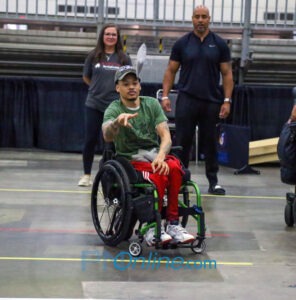
For Jalen, who served from 2013 to 2018 and sustained a level T-10 spinal cord injury (SCI) from a gunshot wound in 2022, the win also marked a couple firsts: his first NVWG and first gold medal.
“I’m glad I’m walking away with something,” he says.
He and his father have some experience with cornhole, though. They often play at home while watching football games. Jalen says having his dad beside him was “everything.” But he also had a full support team of family, including his mom and an aunt, an uncle and a cousin who live in Detroit.
“We were already just thrilled about the entire week, so just being able to, you know, medal in a game that we’re familiar with and being able to win it all, you know, it was just so rewarding,” Mark says. “The competition, along with the trash talking, it’s the best.”
Jalen also received encouragement from Scott Winkler, a two-time U.S. Paralympic track and field athlete, who gave him some tips and shouted, ‘Yes!’ when Jalen got the bag on the board.
“Just getting advice from somebody who’s at that level, I guess, could just motivate me to have something to strive for,” Jalen says.
He says the NVWG is a great platform for people with all kinds of disabilities to meet others like them and find support.
“When I first got here, the opening ceremony was a lot more than I expected,” Jalen says. “I kind of was a little overstimulated when I first rolled out there. But I think it’s great for anybody who are, like, newly injured who are not really sure if they want to get out there. I think they should because I was the same way. And this was my first time flying again since my injury, and they make the process smooth for you.”
Mark says competing at the Games has changed his son’s outlook.
“I mean, the vets have been telling him, you know, this will change his life,” Mark says. “They’ve been telling him that for two or three years — ‘Come on out.’ So, he finally took that step forward.”
Keep Pushing Forward
Veteran wheelchair athletes took a couple cycling laps around Belle Isle Park in Detroit Monday morning, as the sun rose over the fifth day of the NVWG.
For Air Force veteran and PVA Arizona Chapter member Barbara Mical, it was a brand new experience.
Originally from Detroit, the 60-year-old Vail, Ariz., resident, who served from 1987 to 2007 and sustained a level C3-C7 SCI as a passenger in a 2012 car accident, competed in the cycling 5K event in her first NVWG.
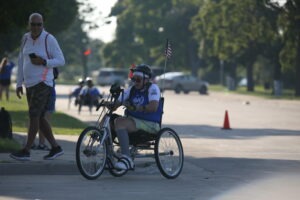
She says her coach, Scott Strzyzewski, has been encouraging her to come and that other veterans shouldn’t feel intimidated and should come out and try the Games, too.
“You don’t know what you don’t know. Had I known it was like this, I would have been out here many years prior,” Mical says.
She says she did her best on the smooth, mainly flat course but had to downshift to get up a couple of hills.
“I thought the course was beautiful. It made me work a little bit getting up the hill, but hey, we did it,” she says. “They were trying to help me up a couple hills and I was like, ‘No, thank you.’ I wouldn’t take help from anybody. So, I did it on my own.”
Although she didn’t compete in sports before her injury, Mical now handcycles twice a week at home and loves being outside. She also competed in 9-ball billiards, cornhole, boccia and the obstacle course known as “slalom.” Now that she’s been to the Games once, she wants to keep going.
“I see a lot of people in the VA with broken limbs or lost limbs, and it seems like your attitude is really everything,” Mical says. “I try to get with people that I see that are down and try to get them motivated or what have you. That’s my thing when I see somebody that’s not doing well. I like to try to encourage. If they want to be upset, it’s OK. There’s been bad days. You want to throw stuff at walls. I’ve done all that. All the crying’s gone. Quit feeling sorry for yourself. You’ve gotta push forward and take what [you] have to make it stronger.”
Army veteran and PVA Wisconsin Chapter member Terrence Green agrees.
“Keep rollin’, keep ridin’, and if you walk, keep walkin’, and keep coming to the Games,” says the 66-year-old Bay View, Wis., resident, who served from 1978 to 2002 and sustained level C4-C7, T11-T12 and L2-L5 SCIs after being shot in 1992.
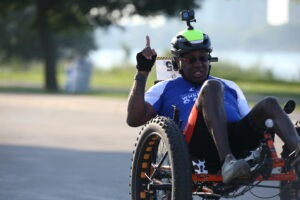
Green says he has cycled since he was a kid and rides about four days a week back home using his orange on/off-road bike with fat, knobby tires.
“You sit up higher and you can see more,” he says. “And I like the color because there’s no way you can say you didn’t see me.”
He says he felt like he did pretty well in the senior classification.
“It was magical,” he says. “People were cheering us on and even the civilians driving their cars were cheering us on, beeping their horns and stuff.”
Green also competed and field events, boccia, pickleball and deadlift.
“As long as you’re not trying to win a medal every time you go to the Games, the Games is the best place to go,” he says.