
Fora Travel advisers share tips for accessible travel
Following a spinal cord injury or disease diagnosis, people often feel like they can no longer do the activities they enjoyed previously, and that includes traveling.
But accessible travel experts from Fora Travel presented just a few of the endless options as part of March’s first Abilities International Accessibility Conference in Long Beach, Calif. A second conference was held April 30-May 1 in New Jersey, and another one will run June 11-12 in Chicago.
The two-day conference held in conjunction with the long-running Abilities Expo was designed for occupational therapists, physical therapists, rehabilitation specialists, assistive technology professionals (ATP), durable medical equipment providers and others in the complex rehab technology (CRT) field to learn, collaborate and ultimately improve care for people with disabilities.
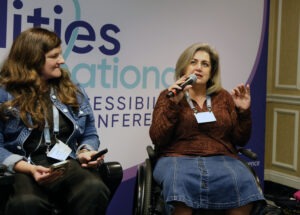
In a session titled Travel As Therapy: Expanding Possibility for Wheelchair Users, Karen Morales, Fora Travel accessibility program lead, and Judy Tudor, a Fora Travel accessible travel ambassador, discussed how travel can support emotional adjustment, acceptance of mobility aids and provide real-world skill building, as well as how physical and occupational therapists can incorporate travel goals into rehabilitation, prepare clients for travel and partner with travel professionals to help clients return to meaningful life experiences.
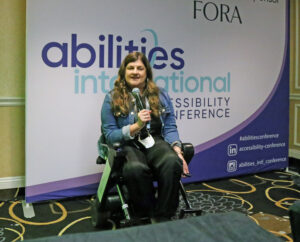
Morales has limb-girdle muscular dystrophy and was ambulatory until 2020, when she tripped on a rug in her home and fell. The ensuing injuries caused her to become a full-time wheelchair user who was afraid to leave the house alone.
“I had used a cane and a walker, and I’d spent my entire existence thinking that I would be holding a microphone one day on a TEDx stage, telling you about how I cured myself from muscular dystrophy. But that day, I realized that it was going to look different. And it was hard,” she says.
She says she most feared losing her independence, freedom, agency and fun. But once she discovered adaptive skiing, she shifted her mindset and has since traveled all over the world. In 2023, she joined Fora Travel, a New York-based startup founded in 2021, and began building its accessibility initiative, which formally launched last year.
For Tudor, who sustained a spinal cord injury at age 16 in 1989 and uses a manual wheelchair, finding other people who believed in her and her abilities was what encouraged her to start traveling.
“I wish that someone would have maybe talked to me about that [travel] as part of my rehabilitation … don’t take it off the table,” Tudor says. “Find those moments to talk about more than just daily living so that people know what is it that I’m living for, so that they can start to think about and dream about what some of those things can look like.”
Getting Started
Morales and Tudor shared some their favorite accessible adventures to give clinicians ideas to discuss with their patients and their families.
Morales says a good starting point is adaptive recreation, from simple outings at botanical gardens, zoos, local food and cultural experiences and amusement parks to adaptive surfing lessons, skiing, tennis or kayaking. In addition to learning wheelchair and problem-solving skills, it reinforces that joy is still possible.
“I think it begins to rebuild your confidence in being out in public. You are one of a few users of a wheelchair or a device among others that aren’t, but it begins to feel a little more normalized if you’re still getting over that shock and awe that this is your new existence,” Morales says.
Her next suggestion is a classic road trip because it controls the pace and environment, and it allows some easy problem-solving in new towns. It can help build confidence for people who are nervous about not having personal equipment with them, such as their Hoyer lift or shower chair. And it can be comforting to know medical backup is easier to come by closer to home.
Morales says she believes taking a solo adventure should be part of every therapy plan, and it can be as short as driving, rolling or walking to new coffee shop in the neighborhood.
From there, the next big step is the first airplane flight. Morales recommends people write down all their wheelchair specifications in both metric and American measuring systems and have them ready at the ticket desk. She says a transfer board or sling with handles can alleviate some fears when boarding. Additionally, make sure the wheelchair comes to the door of the plane, and if the wheelchair gets broken, never leave the airport without an incident report.
She says Barcelona, Spain, and Japan have excellent accessibility. In addition, Amsterdam has accessible roll-on canal cruises, and Portugal is an emerging accessible destination with the ability to obtain affordable nurse care and roll-in vehicles, she says.
Bucket list adventures she’s helped people with disabilities plan include safaris, Machu Picchu, the Galapagos and Antarctica.
“If you had a client that really wanted one of those bucket list trips, you need a good crew of friends. You probably need like a five or six to one ratio. You need an off-road chair, and you need to carefully source your accommodations, but it can be done,” Morales says. “There is not anything you can’t do. Do you want to go trekking with the gorillas in Rwanda? If you’re willing to get carried like a queen, you can do it. Do you want to go up Kilimanjaro? Also possible … Everywhere in the world has workarounds, and there are plenty of people that are willing to do it, if you can get there.”
Cruisin’ Along
Morales and Tudor recommend cruises for people who want to start traveling. Having access to a medical facility on board can be helpful, and Tudor says most of the major cruise lines do a good job with accessible staterooms. However, it’s important to book very early because the rooms go quickly.
“I would recommend if you’re looking at a cruise, it is better to go with a newer ship because they just have refined their design in terms of having more doors that open automatically,” Tudor says. “They’ve made the thresholds a lot flatter to get from the outside to the inside of the ship.”
She says some cruise lines offer basic accessible excursions, but it’s often necessary to contact companies outside of the cruise lines for more options. Tudor says wheelchair users also need to be mindful of the need to transfer to tenders, which are smaller boats that take passengers into the port. If a cruise must use a tender port rather than a dock, Tudor says it can be hit-or-miss if someone who uses a wheelchair will be able to get off the ship.
“Some cruise lines have refined that a little bit,” she says. “I have really enjoyed doing Celebrity cruises because on their newer cruises, they have a thing on the outside called the magic carpet. And that is a platform that moves up and down, and they can use that when they have tenders to make sure that they have a solid platform to be able to get up from the cruise ship onto the tender. However, it is very weather-dependent.”
Morales notes that river cruises are not currently accessible, but lobbyists are working with cruise companies to change that.
As a travel adviser, Tudor can also help people plan for medical issues. Besides knowing what medical resources are available in the area and where the closest pharmacy is, she can arrange to have a nurse available to travel with someone or meet him or her at a specific location, or see that oxygen tanks are delivered to a cruise stateroom or hotel room.
Morales says it’s important to have a plan for medical emergencies and to always travel with medical evacuation coverage. When she travels in remote locations, she uses Global Rescue.
She says the logistics of planning an accessible trip can feel overwhelming, but she’s found people around the world really do want to help.
“It’s very hard if you’re living with a degenerative condition and there is no improvement,” Morales says. “It’s hard to stay motivated. And I think sometimes these types of experiences can make up for what you’re not seeing as gains in a gym or improvement in your condition, or you can at least think you’re getting exposure to new experiences, and that can take away some of that pain.”
For more information on the Abilities International Accessibility Conference, visit abilitiesconference.com, and read the August issue of PN.
For information on the Abilities Expo, visit abilities.com.