
Discover what’s inside the September 2026 Paraplegic News issue with this month’s complimentary article, “AI For Everyone” selected by our editors.
A new tool is testing the accessibility of websites made using artificial intelligence.
Artificial intelligence (AI) is slowly creeping into nearly every aspect of new technology. And just like many advancements that came before it, AI has great potential to increase accessibility for people with disabilities, including those with spinal cord injury and disease (SCI/D).
Now, a team of technology experts and accessibility advocates is working to ensure that potential is maximized, especially for assistive technologies such as voice control, eye-gaze tracking or switch devices to navigate computers and the internet.
Launched earlier this year, the AI Model Accessibility Checker (AIMAC) is the industry’s first standard for evaluating how well AI models generate accessible code that ensures assistive technologies can accurately interpret and interact with a website.
Among the team who developed the AIMAC are Joe Devon, Eamon McErlean and Ben Ogilvie.
Devon co-hosts the Accessibility and Gen AI Podcast and cofounded Global Accessibility Awareness Day (GAAD) with digital accessibility advocate Jennison Asuncion in 2011. McErlean is co-creator of the AIMAC and vice president and global head of digital accessibility at ServiceNow, and Ogilvie is the director of accessibility strategy at ArcTouch and GAAD Foundation board member.
Over the past two years, they have developed and launched the AIMAC, which Devon says is like a report card for AI
model companies.

When websites lack proper accessibility, such as missing keyboard support, inadequate focus indicators or poorly structured content, adaptive tools can’t function correctly, effectively locking people out, Devon says.
“AIMAC measures how well AI models generate accessible HTML, which matters because AI is increasingly building the web interfaces we all use,” he says. “Our research shows significant variation between models. Some produce more accessible code by default, others create more barriers. By benchmarking and publicizing these differences, we push the industry toward AI that works for everyone.”
Working With Assistive Tech
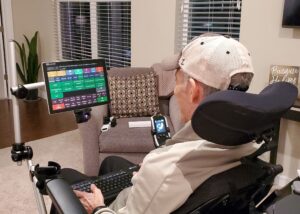
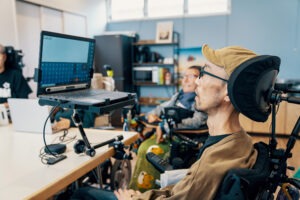
People with motor disabilities often interact with online content using assistive devices that connect their abilities to their hardware. These could include a mouth stick that replaces a keyboard, alternative keyboards, sip-and-puff devices or eye-gaze trackers that allow people to use a computer with eye movements.
However, according to a 2026 WebAim Million report, which analyzes the home pages for the top 1 million websites using international Web Content Accessibility Guidelines (WCAG), 95.9% of the home pages had at least one WCAG failure.
Ogilvie says when products are built with WCAG as a standard, it makes it much more likely that the code will work well for assistive technologies and allow someone who can’t interact with touch screens, computers, websites or apps in a traditional way to continue to get the most out of that technology.
In addition, Ogilvie’s company, ArcTouch, conducted a study last year that manually tested WCAG compliance for 50 of the leading Android and iOS apps across food and delivery, payments, fitness, shopping and streaming industries and found that 72% had either a poor or failing experience for users with disabilities who were using assistive technology.
Some accessibility violations might include:
- Small touch-target sizes, which are difficult to navigate for people with amyotrophic lateral sclerosis or a high-level SCI without finger dexterity.
- Products that time out or log out the user without the ability to extend the time. Some assistive technology users require more time to complete certain tasks.
- Low color contrast or lack of alternative text to describe photos.
- Improper tab order or missing form labels.
- Frequent pop-ups, which can block users from task completion and don’t allow assistive technology to focus on the correct target, leading to fatigue.
“So, if you can’t actually get to the tiny little close button, that X button, to dismiss the pop-up, that’s a violation,” Ogilvie says. “That’s a failure because it’s diverting your attention and preventing you from actually accomplishing what you’re there to accomplish.”
Ogilvie also says some people don’t have the dexterity to control a mouse and only use a keyboard for inputs. If a site isn’t coded well, it might skip over an entire website element, in which case it doesn’t work for people who are navigating with alternative systems.
And because AI is trained on the data that already exists, many accessibility advocates are concerned these errors will be duplicated as more and more companies move to coding using large language models (LLMs).
Ogilvie has personally seen the need for a tool like the AIMAC. When his father, Staman, sustained a quadriplegic SCI in a 2009 bicycling accident, Ogilvie wanted to retrofit a laptop computer so his father could continue to work. Not only was the laptop not designed for someone who couldn’t use his or her fingers on the trackpad or keyboard, but the websites his dad was using also weren’t made for someone who needed to interact with technology through voice control.
“That’s the way digital products have been built for many years, and AI is just replicating those same things because it’s trained on the same core code,” Ogilvie says. “So, if we don’t kind of inject the guardrails into those AI models to kind of redirect their attention to pay attention to building products in a way that’s better than what’s been done in the past, it’s just going to compound more and more inaccessible stuff that exists in the world than there is even today.”
Start At The Source
That’s where the AIMAC comes in.
Devon says the WebAIM Million report was a major inspiration for the project, and 28 of its website categories were included in the AIMAC. The tool prompts AI model companies to generate HTML code and then tests the code’s accessibility.
Using an industry-standard automated accessibility checker called Axe-core by Deque Systems, the team initially tested 37 models, with several of the most well-known from OpenAI’s ChatGPT, Anthropic’s Claude, Google’s Gemini and xAI’s Grok, in December 2025.
Devon says OpenAI is far the best foundation model company thus far when it comes to the AIMAC benchmark. In June, OpenAI held the top five ranked positions.
Anytime there’s a major update for a model, they run the AIMAC. Devon says it has sometimes cost upwards of $300 to run a full check, so they rarely rerun old models. As of June, AIMAC had tested 36 models, and every update has an explanation of which models were added or removed.
“People donate [to the foundation] because they want to see that AI keeps up with accessibility, to be like the first technology where accessibility is a first-class citizen right at the beginning, instead of waiting 20 years like every other technology,” Devon says.
The AIMAC is open source, so anyone can download the tool and capabilities and check any LLM.
However, Devon says automated testing only captures 30% to 50% of the accessibility issues. Companies still need qualified accessibility testers to look at each HTML page manually. But for the initial version of the AIMAC, Devon didn’t want to give the AI model companies complex procedures that would require expensive manual testers to fix their products. Once companies hire an accessibility team, they will eventually get manual testers. But in the short term, Devon says they should implement the automated testing as a first step.
He says the idea is to get the models to compete, and once they’re all scoring well, they can move to the next level. His team hopes to develop other benchmarks, and he is contacting leaders at AI model companies to let them know about the AIMAC’s availability.
Ogilvie says starting at the AI source is the key.
“It is drastically more expensive to fix this later than to do it right from the beginning, which is why going to the source of where most new code is going to come from, from now on, and try to fix it there is the kind of point of leverage that it makes most sense to pull on. Because once it’s out there, it is dramatically harder to go back and retrofit, and it derails product teams, it derails budgets and timelines and all kinds of stuff,” Ogilvie says.
Increased Awareness
Devon and Ogilvie say the benchmark’s goal is to increase awareness, which is also GAAD’s goal. In 2011, Devon cofounded GAAD, inspired by his father Charles’ struggles with a banking website where he couldn’t see the contrasting colors.
“And as his son, that was very infuriating to see, to see my dad struggle with that,” Devon says. “And it just felt like a human right, which is exactly why the civil rights act, the ADA [Americans with Disabilities Act], it was all about this being a civil right. If you cannot bank, you cannot be independent. And there’s no reason that this shouldn’t be accessible.”
GAAD started out as simple blog post and within a few years turned into a global movement with hundreds of events and observances held annually on the third Thursday of May. Devon says his dad lived to see the beginnings of GAAD but not what it eventually became.
“Global Accessibility Awareness Day amplifies this message: Accessibility isn’t a niche concern; it’s fundamental infrastructure,” Devon says. “For someone with ALS [amyotrophic lateral sclerosis] whose only computer access is through eye-tracking, an inaccessible website isn’t an inconvenience. It’s a closed door.”

McErlean says everyone uses accessibility features daily in one way or another.
“Good coding ultimately helps everyone,” McErlean says. “It’s needed to be fully inclusive, but it
does help everyone.”
For information about the AIMAC, visit aimac.ai.