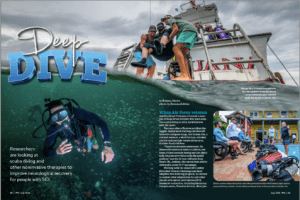

Discover what’s inside the July 2026 Paraplegic News issue with this month’s complimentary article, “Deep Dive,” selected by our editors.
When Air Force veteran and Paralyzed Veterans of America member-at-large Brian Schiefer first tried adaptive scuba diving in 2018, he fell in love
with the sport.
Ten years after a Humvee accident during pre-deployment training exercises left him with collapsed lungs, two broken ribs, a cracked sternum, a skull fracture, a broken clavicle and multiple vertebral fractures, Schiefer finally felt free.
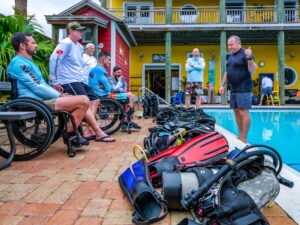
“There’s no obstacles underwater. No issues with barriers or stairs or curbs or, you know, it’s just mentally freeing and also physically, because now you’re not in the seated position,” says the 42-year-old Santa Rosa Beach, Fla., resident, who served from 2002 to 2009 and is a level T6-T7 paraplegic.
Working with the nonprofit Combat Wounded Veteran Challenge and their adaptive dive training program, he started to explore what adaptations he and other people with spinal cord injuries (SCI) needed to scuba dive, including buoyancy compensators, flotation devices, diver propulsion vehicles and universal aids for getting on and off the boat.
Six years later, he started his own nonprofit organization called SCI-DI, which is focused on researching the physiological benefits of scuba diving and other noninvasive modalities to help others like himself recover from their injuries.
“In the military, we learn one thing early: When the mission hits resistance, you don’t stop. You adapt, innovate and push through,” Schiefer says. “Spinal cord injury threw up the biggest resistance I’ve ever faced. Chronic inflammation became the barricade, and I’ve spent the last few years proving that barricade isn’t unbreachable.”
Three-Pronged Approach
Schiefer and his team are intent on translating their research to clinical use. He describes SCI-DI’s three “pillars” as scuba and hyperbaric oxygen therapy (HBOT), noninvasive neuromodulation and psychedelic-assisted approaches that target inflammation.
“We focus on multiple modalities because we believe it’s not a one-size-fits-all,” he says. “We’re all physiologically so different, how can we expect one protocol to work for everyone?”
To create adaptive diving protocols, studies and equipment, Schiefer enlisted the help of several medical, academic and subject matter professionals with various specialties, including William “Jamie” Tyler, PhD, a neuroscientist and faculty member at the University of Alabama at Birmingham. One of Tyler’s companies developed a transcutaneous auricular vagus nerve stimulator called BRAIN Buds (brainbuds.com) while working on contracts from the U.S. Department of Defense.
Together, they began measuring Schiefer’s sleep quality and patterns, heart rate, blood oxygen levels, cognition and heart rate variability, or the time between consecutive heartbeats which can indicate either recovery or stress, both before and after scuba diving and how long those effects lasted.
Now heading up research with Schiefer for SCI-DI, Tyler worked to help develop many of their early diving adaptations.
“We started looking into developing standard operating procedures for scuba divers with a spinal cord injury. We had to work on methods to assist divers with buoyancy and gear like diver propulsion systems. We had to figure out how they can use state-of-the-art equipment like underwater positioning systems and diver propulsion vehicles without sinking them,” Tyler says. “So, the other side of our work is kind of like the equipment side. How can we push technology to make better strides for the adaptive diving community in terms of gear and equipment?”
But better equipment is only the beginning of what SCI-DI hopes to accomplish. Besides Schiefer’s lived experience, the inspiration for SCI-DI’s scuba diving work stems from a 2011 study by Adam Kaplin, MD, PhD, and Daniel Becker, MD, in partnership with the nonprofit Cody Unser First Step Foundation.
Unser, the daughter of two-time Indianapolis 500 winner Al Unser Jr., and the late Shelley Unser, was paralyzed at age 12 in 1999 from transverse myelitis. After experiencing physical changes, such as improved bladder sensation and tingling in her legs, following scuba diving excursions, Cody convinced Kaplin and Becker to investigate the psychological and physiological changes that paralyzed people experience when scuba diving.
“It’s reimagining what rehabilitation is and means for people with disabilities and not just prescribing a pharmaceutical remedy, which I think is huge because the lived experience gets completely ignored,” Cody says. “And, you know, the medical model of disability is so prevalent in our society. And we focus too much on what we can’t do instead of what we can do. And that’s kind of how I convinced my doctors this is something I can do and something I’ve noticed.”
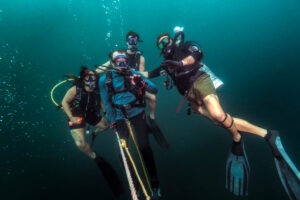
by divemasters during a decompression stop. (Photo by Romona Robbins).
The study involved 10 paralyzed veterans, including several PVA members, who went to the Cayman Islands and did nine dives over four days. Eight of the 10 participants ultimately completed the dives. The researchers conducted standard mental and physical tests on the group and their dive buddies as healthy controls before and after diving. Kaplin also conducted a mood study using text-messaged responses before and after the dives.
The results showed spasticity reduced on average by 15%, and sensitivity to a light touch increased by 10% and a pinprick by 5%. Some of the veterans had improvement in sensation and motor function between 20% and 30%. There was also an 80% reduction in post-traumatic stress disorder symptoms among the five veterans with those symptoms, as well as a 15% reduction in obsessive-compulsive disorder and depression symptoms. Some of the veterans also reported better sleep. However, the effects were not permanent, and the study was too small to draw any firm causation.
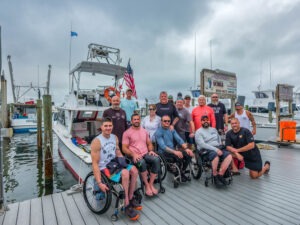
SCI-DI researchers hope to replicate the study with 10 to 20 divers to get a baseline and build on that research once they secure funding. Their initial pilot study in September 2024 with five SCI veterans in Destin, Fla., was cut short due to hurricanes. However, they completed two open-water dives per day over three days at 60-plus feet and gathered some preliminary data on sleep quality, psychosocial aspects and heart rate variability.
For the next iterations, Tyler wants to evaluate stress biomarkers, inflammation and levels of cytokines, which are small proteins that affect inflammation, in blood and to track those markers over time. Other studies may even incorporate smart dive watches that track heart rate, heart rate variability, oxygen levels, activity levels, sleep and more before, during and after dives to see if the interventions make an objective physiologic difference.
“There’s quite a bit [of research] exploring what happens when you take groups scuba diving, their mental health gets better,” Tyler says. “But what we want to know is do you see meaningful reductions in spasticity? Do you see better thermoregulation? Do you see better cardiac regulation? Because the hypothesis is some of those things would be improved based on the medical physics of diving while breathing compressed air.”
Extended Results
In conjunction with the scuba research, Schiefer and his team are also interested in incorporating HBOT to either replicate or enhance diving’s effects.
HBOT involves breathing 100% oxygen inside a pressurized chamber, which increases blood oxygen levels and promotes healing. It produces similar effects on the body as diving, but it has added effects due to the actions of compressed oxygen.
“There’s good data behind the theory or the hypothesis that oxygen delivered under pressure, or hyperbaric medicine essentially, decreases inflammation in the central nervous system and increases your serotonin levels,” says Cheryl Lowry, MD, MPH, FAsMA, FAWM, one of SCI-DI’s medical consultants and physician with Tactical Mind Solutions. “So, the old theory was, well, you get what you get with your nervous system, and when you break it, it’s done forever. But we realize now that the brain is more of a neuroplastic organ. So, you can’t necessarily replace old brain tissue, but you can induce more connection through … the use of other neuromodulation techniques, including diving and hyperbarics.”
Schiefer and Tyler envision HBOT as an alternative therapy for people who don’t have the access or the means to go scuba diving on a regular basis. It could also be used in combination with scuba to extend the physical effects and promote more neural regeneration.
“The water’s an equalizer on so many levels, but for someone with a spinal cord injury who struggles to move around in the environment, they’re weightless and free and they can move and swim. It’s a game-changer,” Tyler says. “And I think that just from an adaptive sports promotion standpoint, I’d like to see adaptive scuba diving move forward. But I think hyperbaric oxygen has got the benefit of you’re able to treat a lot of people quickly who may never get near the ocean.”
Other Studies
Other SCI-DI projects involving noninvasive neuromodulation via vagus nerve stimulation and psychedelics also aim to reduce inflammatory responses, promote neuroplasticity and improve overall physical and cognitive health for people with SCI.
Schiefer has frequently used Tyler’s BRAIN Buds vagus nerve stimulation device to calm his autonomic nervous system before diving and to help with recovery after dives.
The vagus nerve runs from the brainstem down through the neck, chest and abdomen and is involved in regulating many bodily functions, including the autonomic, immune, cardiovascular, gastrointestinal and respiratory systems. Stimulating the vagus nerve has been shown to switch on the parasympathetic, or “rest and recover,” nervous system. Tyler says the stimulation also helps decrease production of pro-inflammatory cytokines.
The effect is similar to what happens when people hold their breath and submerge their faces in cold water, Tyler says. The protective physiological response called the mammalian dive reflex causes blood vessels to constrict to conserve energy, control breathing and decrease the person’s heart rate.
In addition, Schiefer says studies are being conducted that show promise for psychedelics in reducing inflammatory responses and promoting nerve regeneration, as well as assisting with mental health.
Certain psychedelics, especially lysergic acid diethylamide (commonly known as LSD or acid), N,N-Dimethyltryptamine (DMT) and psilocybin (also called magic mushrooms), have been shown to produce anti-inflammatory effects that can last up to two weeks after a single dose. Psilocybin already has Food and Drug Administration “breakthrough therapy” status for major depression and treatment-resistant depression, and new studies are quickly being published.
Among those upcoming studies is research by Tyler, who is also co-founder and chief technology officer of Diamond Therapeutics, Inc. Later this year, the company will be studying the effects of low-dose psilocybin on anxiety in veterans as part of phase 2 clinical trials in Tampa, Fla.
And Schiefer says Charles Nichols, PhD, and his team at Louisiana State University are developing psychedelic-like compounds that deliver strong anti-inflammatory benefits without the intense hallucinogenic effects that might turn people off to a psychedelic experience.
Schiefer says his personal experience with psychedelics was that it made him feel connected to his body again.
“It’s almost like your body and your brain are trying to make a new form of connection which, in turn, helps you love yourself, so you can kind of project that into the world, as well,” Schiefer says. “But it wasn’t until I did my first psychedelic experience that I actually had that. For probably almost a decade, it felt like I was dragging around the dead weight of, you know, my injury and everything that I couldn’t feel. So, this pillar isn’t just about tripping, but it’s using these tools in the right setting to reduce inflammation, promote neuroplasticity and help the other two pillars to work even better.”
Schiefer says SCI-DI is working to build partnerships and gather data to ultimately deliver protocols for a combination of these therapies.
“SCI-DI is focused on separating fact from fiction by generating credible data, building safe access pathways and transitioning science into therapies that veterans and others with SCI can use today,” he says.
For more information, visit sci-di.org.
For stories like this and more, subscribe to Paraplegia News today!