
Discover what’s inside the August 2026 Paraplegic News issue with this month’s complimentary article, “Finding The Hive,” selected by our editors.
Finding The Hive
by Lynne Switzer
Beekeeping has a history spanning at least 4,500 years. And today, a growing number of veterans and people with disabilities are discovering the hobby for themselves, aided by organizations that provide training, community and tools that make working in an apiary more accessible than ever.
Imagine yourself outside on a beautiful afternoon, the air around you layered with a sweet and smoky aroma. It’s a scent so complex, it changes by the season, by the hour, by the bloom. It leaves you transfixed.
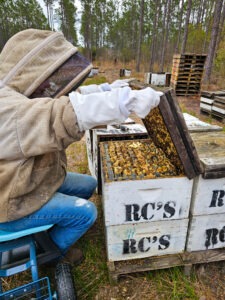
“Inside a hive, everything else disappears,” says Steve Jimenez, founder of Houston-based Hives for Heroes, a national peer-to-peer beekeeping mentorship organization for veterans and first responders. “Finance, relationships, stress, problems … all of it goes away.”
For Jimenez, a U.S. Marine Corps veteran, that disappearing act was nothing short of life-changing. After leaving the military, he was struggling with isolation and a sense of purpose. A friend asked him to go beekeeping. “I said, ‘Absolutely not,’ because it sounded crazy,” he says. “But I went because she needed company.” What happened next surprised him. The bees gave back what years of civilian life had quietly taken away: presence, calm and a sense of mission. Today, Jimenez leads Hives for Heroes with a clear-eyed purpose.
“Our mission is keeping guns out of mouths,” he says. “Bees are simply the conduit for healing, connection and purpose.”
A New Mission
Jimenez’s experience is far from unique. Beekeepers across the board describe the practice as calming, restorative and deeply absorbing. But the people who have found their way to the hive often describe something broader than stress relief. They talk about the purpose and responsibility of caring for a living colony and the simple act of paying attention to something beyond themselves.
That therapeutic potential has attracted people outside the traditional beekeeping community. Through a partnership between another organization called Heroes to Hives and the Department of Veterans Affairs (VA), recreational therapists have studied beekeeping as a wellness activity for veterans. In one VA study, participants who spent just one to two hours working with bees reported significant reductions in anxiety and depression. VA clinicians are incorporating the hobby into recreation therapy and whole health programs.
Perhaps it’s because a hive is a very complex, organized and fascinating system. A healthy honeybee colony can contain roughly 60,000 bees, wherein almost all are female workers rotating through multiple jobs, including nurse, guard, builder, undertaker and forager, during their short lives.
“It gives people something to focus on outside themselves,” Jimenez says.
Because handling a hive requires slow, deliberate attention, the work pulls people into the present moment, reconnects them with nature and provides a sense of responsibility. For people carrying the weight of an injury, trauma or loss, that can be transformative.
Two programs with similar names but distinct approaches are doing some of the most meaningful work in the field. Hives for Heroes, founded by Jimenez, connects beekeepers nationwide through peer mentorship. Heroes to Hives, a science-based education program cofounded by entomologist and Army veteran Adam Ingrao, runs out of Michigan State University and has trained nearly 20,000 people, offering certification and college credits. Ned Stoller, an AgrAbility assistive technology specialist, works alongside Ingrao to help people with disabilities access the hobby safely through tools and techniques.
For Ingrao, beekeeping is both a vocation and lifeline. He left the Army after a service-related injury, finding a new mission in honeybees. But years later, a serious automobile accident left him with physical challenges that made him wonder whether he could continue keeping bees at all.
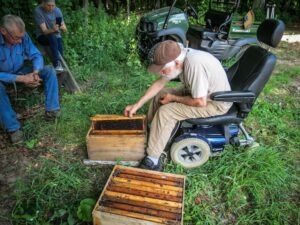
The good news was he certainly could continue. With Stoller’s help, Ingrao rebuilt his practice with new accommodations, and that experience made him a more effective advocate for others doing the same. His work today with Heroes to Hives has him educating new beekeepers and helping veterans reconnect with a purpose — a continuation of his service mindset.
“I couldn’t serve our national security anymore,” he says. “But I could serve our food security by protecting pollinators.”
One Veteran’s Hive
About 45 miles south of Bloomington, Ind., Marine Corps veteran Hack Albertson tends six beehives on a flat stretch of asphalt driveway on his property from his power wheelchair. The Paralyzed Veterans of America Kentucky-Indiana Chapter member discovered beekeeping about three years ago after reading about Heroes to Hives in a VA newsletter. He called. They sent him a hive, the bees and a suit.
He harvests between 60 and 100 pounds of honey per hive in a good season. But getting there required some creative problem-solving. The traditional Langstroth hive — the tall vertical box most common in American beekeeping — presents significant challenges for wheelchair users. A full honey super, which sits on top of a beehive for extra honey storage, can weigh 40 to 50 pounds. And a full brood box, which is the lower portion where the queen lays her eggs, can exceed 100 pounds. For wheelchair users and people with limited mobility, balance issues or reduced grip strength, that setup can quickly become impractical.
Fortunately, hive design is only one part of the accessibility equation. Adaptive frame holders, hive carriers, elevated work surfaces, ergonomic tools and modified layouts can all help reduce lifting, improve stability and make hive management safer. Albertson’s chair elevates to give him better access, and he works hive inspections one frame at a time, rather than lifting whole boxes, using a side attachment to hold frames while he works. He’s also switched two of his hives to a long Langstroth design, which is a horizontal version that keeps everything at one level, making it more wheelchair-friendly.
“I was just blown away that something like this has been thought of to be adapted for people in chairs,” Albertson says.
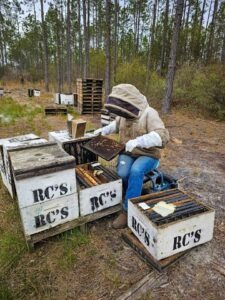
Hive Adaptations
The most significant accessibility innovation in beekeeping may be a hive design that’s unknown to most Americans.
In Slovenia, an entire beekeeping culture has developed around the AŽ hive (also called the Aja hive). While the Langstroth requires lifting heavy boxes from the top, the AŽ hive is worked from the back. It’s composed of individual frames that slide out horizontally, like books from a shelf. The hives are housed inside a small building or shelter and can be managed from nearly any position, including a wheelchair.
“I worked with the paraplegic beekeepers association out there specifically, because they have an entire beekeeping association of folks that are wheelchair-bound that are able to keep bees just like everybody else,” Ingrao says of his visit to Slovenia.
Ingrao has worked with amputees, including one double below-knee amputee who was beekeeping at a commercial scale, as well as beekeepers managing significant back and joint injuries. He and Stoller also know a partially blind beekeeper who has been developing artificial intelligence (AI)-assisted software for visually impaired beekeepers through a U.S. Department of Agriculture grant.
“I can definitely see a fully blind beekeeper being very successful with the assistance of AI,” Ingrao says.
Getting Started The Right Way
Every expert offers the same first piece of advice: Educate before you invest.
“Take a year to learn,” Ingrao says. This is so you set yourself up for success and don’t contribute to colony losses. Heroes
to Hives offers free introductory content on YouTube and a full certification course. AgrAbility provides personalized guidance on equipment adaptations. Hives for Heroes connects newcomers with mentors and a national community. Most counties also have a local beekeeping club, which is a welcoming, low-stakes place to meet people and gather information.
When it comes to cost, a standard entry-level setup with two Langstroth hives and full equipment runs roughly $1,000, according to Ingrao and Stoller. For those interested in the more accessible AŽ hive, expect to invest closer to $5,000, both say. And extraction equipment adds roughly another $1,000 for those who want to process their harvest. Heroes to Hives now has AŽ hives at its farm and is developing a course around them. For anyone weighing the investment, Stoller offers perspective: “For an entry point in agriculture, there’s no other place you can get into that field for that price point and not own land.”
Taking a few extra steps to ensure safety is worth the investment. You’ll want to clear the area around your hives of tripping or wheeling hazards before you begin, and you need a safety plan. This means knowing your allergy status, carrying an EpiPen if there’s any risk and making sure someone always knows where you are. For anyone with a disability, a partner model can make a real difference, and that echoes something veterans already understand.
“I’m not from the military,” Stoller says. “But I know they don’t go on special ops alone.”
The sense of peace the hive offers may be the best argument for adaptive beekeeping, more than any program or piece of equipment could offer.
“Nature heals,” Stoller says.
And for anyone who thinks it sounds wonderful but impossible, he has one more thing to say: “There are thousands of people doing it. Why couldn’t you?”
Albertson frames it more quietly. Most mornings during the warm months, he wheels himself out beside the hives and listens. He watches the bees rise into the air and waits to see whether anything needs his attention. Most days, nothing does. He can simply be there, observe and be amazed. Which, it turns out, is exactly the point.
Lynne Switzer is a writer, content strategist and founder of Porchlight Stories, specializing in human-interest narratives that illuminate how ordinary people navigate extraordinary challenges, particularly in the disability community.