
Discover what’s inside the May 2026 Paraplegic News issue with this month’s complimentary article, selected by our editors
Each year, the giant consumer technology trade show known as CES convenes in Las Vegas.
With more than 60 acres of exhibit space, it’s easy to get sidetracked by the newest innovations, from drones and humanoid robots to augmented and virtual reality glasses and massive televisions.
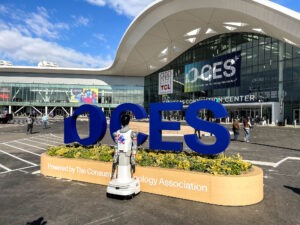
But CES is about more than just the latest gadgets. The event includes a conference program where business leaders and experts discuss hot topics in the industry, including the importance of accessibility.
This year’s show Jan. 6-9 was no different. In addition to an expanded accessibility conference track, the Accessibility Stage made its debut on the show floor, bringing even greater awareness to the technology needs and importance of the disability and aging communities.
Bridging The Gap
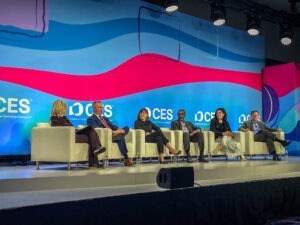
Among more than 30 conference sessions involving accessibility topics, a panel featuring Paralyzed Veterans of America (PVA) CEO Carl Blake and several other leaders from some of the nation’s largest and most respected mission-driven groups discussed how technology, data and artificial intelligence (AI) are transforming access to life-changing resources and care.
Blake joined Claire Casey, president of AARP Foundation; Derrick Johnson, president and CEO of the NAACP; Jacquelyn Puente, vice president of external affairs at Comcast Corporation and chair of the U.S. Hispanic Chamber of Commerce; and Barron Segar, president and CEO of World Food Program USA, along with moderator Gretchen Littlefield, CEO of Moore Group, to talk about Bridging the Opportunity Gap for Underserved Populations.
Littlefield asked the panelists how AI and automation are changing the landscape for the people they serve, including both the risks and the emerging opportunities. For Blake, it was clear that while technology opens possibilities and remains crucial to serving PVA members, meeting them where they are and delivering information, it’s difficult for a large, older organization to be as dynamic as the fast pace of advancements.
“Where technology matters is the vast majority of the people that we support and that we serve find challenges in everything they do in everyday life,” Blake says. “There are physical access barriers. There are barriers of every kind, and technology allows them to overcome many of those barriers. Maybe not all of them, but many of them. And at the same time, it allows us to come to them and reach them in their home and deliver the support that they need.”
When it comes to AI, Blake admits he maintains a healthy skepticism. He says PVA has a responsibility to protect the personal information of the organization’s millions of members and donors from bad actors who are also looking to take advantage of AI.
“Nothing could undo the work that we do as an organization faster than if we allow that information to be compromised, and where AI can protect it, it can also be weaponized against it,” Blake says. “I think we just have to be very deliberate and thoughtful and careful, because AI is moving so quickly that we are prepared to put up the firewalls that we need to, to guard that information. Otherwise, we could we run the risk of doing more harm. Not to say that bad actors are always looking to get into that space, but it is a vulnerability with no clear, absolute safeguard.”
The panelists also discussed the need for nonprofit companies to weigh in on AI public policy guardrails and to invest in technology and AI infrastructure to allow them to continue carrying out their missions.
“We’re an 80-year-old organization, and we don’t want to look like an 80-year-old organization,” Blake says. “It’s impossible for us to be on the cutting-edge because the cutting-edge is what you see here [at CES]. But if we’re going to be an effective nonprofit organization that’s going to serve our members well and deliver the services in the most optimized way and operate as a business, because we’re also a business, in the most optimized way, there’s a lot we can learn from what we see here, and how to apply some of that to the work that we do.”
Blake also spoke about the recent impact PVA has seen by tapping into social media influencers.
“The only way to really influence change in policy is to activate people,” Blake says. “You can use the data tools and the tech tools to spread the message far and wide quickly, but people influence people, and it’s amazing the impact we have seen from engaging the right influencers … the key for us is to use our tools to make sure they have the right information at the right time, expeditiously, so that they can help us change policy and make a difference.”
Voices Of Accessibility
Another conference session titled Voices of Accessibility: A C-Suite View on Progress & Innovation included accessibility leaders who discussed how large companies are prioritizing accessibility to drive progress and innovation, how inclusive design can be a catalyst for the next generation of technology and user experience and how accessibility is everyone’s responsibility.
The panelists emphasized the value of incorporating accessibility features at the outset of product development, as well as involving people with disabilities in the design process.
Fred Moltz, chief accessibility officer of Verizon, says people with disabilities now play a major role when companies are developing new products and services.
“And as anybody can imagine, that’s really important because we’re building it up front,” he says. “You’re not doing it as an afterthought at the end. You’re not doing it without talking with people in the disability communities about what we’re trying to provide. It’s all up front. So, whether it’s a design, it’s a user story, it’s testing through the lifecycle, it’s all these little pieces that all we asked for was a seat at the table to be part of it, and now we are. And it really does make a big difference. And that, to me, is where you see that real innovation coming to life, because now we are being inclusive in building it for everybody.”
Will Scott, head of AI technology in the Carbon Design Systems at IBM, says companies must also promote an inclusive workplace by providing employees with a robust catalog of accommodations and resources, like IBM does.
“The first individual with a disability was hired by the company [IBM] in 1914,” he says. “In 1942, a psychologist [who was blind] created a program that would train individuals as employees for the company that had various disabilities. And actually, that was during the backdrop of World War II, so, you know, hiring veterans to move them into the workplace.”
Jenny Lay-Flurrie, chief accessibility officer of Microsoft, says inclusivity and accessibility can help companies achieve their mission, as well as increase their customer base.
“So, it’s kind of a no-brainer,” she says. “If you don’t make your stuff inclusive and accessible, you’re literally excluding people. And so, I think it’s a very human thing, particularly important at these times, that tech companies and every company remember that accessibility isn’t optional. It just needs to be done. And if it isn’t, you will be disempowering people in the workplace, at home and in life.”
Mahyar Nejat, vice president of engineering for Sony, says it’s about more than just complying with regulations, and advocacy groups can be helpful to gather lived experiences, knowledge and requirements to create a feature or product that includes all needs.
“It’s not just for social responsibility or something to do, but it makes the company profit and move forward. It can be a good thing for the society, as well,” he says.
Scott says companies that adopt the “shift left” approach, which brings testing, security and quality assurance activities to the beginning stages of product development, can avoid leaving accessibility to be tacked on at the end and costing the company time and money.
“A colleague of mine said it this way: ‘It’s like trying to add blueberries to the muffin after.’ You gotta put the berries in at the beginning, right?” Scott says. “So, that’s what we’re doing. We’re using AI to do this, and hopefully with this inflection point, get it right this time.”
However, even with all the possibilities AI offers people with disabilities, Lay-Flurrie says it remains mostly inaccessible because it’s been trained on inaccessible websites and imagery that isn’t representative of disability.
“About 2% of the world’s websites are accessible, some say up to 4%. That means that 96% are not,” she says. “We have this really crux moment right now where we’ve got a new era of technology that could repeat the mistakes of the past, or it could completely blow the doors off … and I really do think we should be following that mantra.”
AI & Assistive Tech
By far the most popular conversation topic of CES was AI, including how it will affect assistive technology. In a session titled New Era of Access: Enhancing Assistive Tech with AI, panelists explained their hopes and fears surrounding AI advancements.
Peter Korn, director of accessibility for Amazon’s devices and services, says the hopes and fears are reminiscent of other technological advances, such as moving from accessible desktop devices to inaccessible smartphones.
“The hope is that this greater awareness will mean things are a little different this time around, versus the last major technology transitions that left people behind, and I’m delighted by the number of disability-led entrepreneurs who are helping define what great looks like when we apply AI to accessibility,” he says.
Marilyn Morgan Westner, co-founder and chief experience officer of Xander captioning glasses for people with hearing loss, says AI needs the voices of more people with disabilities to inform how it’s created.
“It’s so easy to use AI to produce really flashy, cool and sometimes inexpensive things that attract a lot of attention and buzz,” she says. “But when it comes down to what people really need, if all that stuff is there and people buy it, but then they throw it in a drawer or they never use it, then it’s not important. And I think the way to get usability, you need trust from users, and that comes from getting their voices and input from the from the get-go.”
Korn says AI holds exciting potential for personalized accessible experiences to help people with a broad spectrum of disabilities.
For example, a device or software might read or highlight only areas of a web page that fit a person’s interests, enhance specific colors for people with color vision deficiencies or boost customized frequencies for those with hearing loss, he says.
However, tech affordability remains a factor. Daniela Braga, founder and CEO of Defined.ai, hopes the rise of humanoid robots can help bring down the cost of expensive specialized wheelchairs and other devices by making similar parts and technology more mainstream.
In addition, Rebecca Rosenberg, founder of ReBokeh, a technology startup that provides accessibility tools for people with low vision, says putting the cost burden on the organization that’s providing the product, rather than on the consumer, could give people greater access.
“I think also thinking about how generalized and how helpful accessibility can be to everyone and treating it that way, truly at the core of your organization, enables us to get to a place where we can lower that cost for the individual end user,” Rosenberg says.
When it comes to personalization, maintaining privacy is also a concern. Rosenberg says it’s about informed consent and empowering people to decide whether the personalization is useful enough to sacrifice some privacy in each use case.
“I think that it’s about making sure that the person who is consenting to use this personalization technology knows what’s happening with their data, knows where it’s going, knows what it’s being used for and that that’s being communicated effectively,” she says.
For more articles like this and more, subscribe today – https://pnonline.com/subscribe/