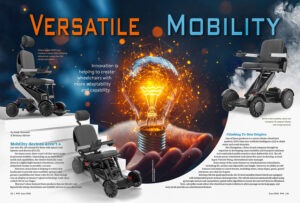

Mobility devices aren’t a one-size-fits-all concept for those with spinal cord injuries and disease (SCI/D).
For many years, there wasn’t all that much range in personal mobility. Depending on an individual’s needs and capabilities, the choices basically came down to a lightweight manual wheelchair, a heavier motorized version or possibly a scooter.
However, innovation is helping to widen that landscape to provide more mobility options with greater capabilities for those with SCI/D. That change was on display at January’s giant technology trade show called CES in Las Vegas.
This year’s show featured three products that are literally and figuratively taking wheelchairs and mobility devices in new directions.
Climbing To New Heights
One of those products is a smart robotic wheelchair made by XSTO that uses artificial intelligence (AI) to climb stairs and avoid obstacles.
The Zhongshan, China-based company brought its expertise in developing smart mobility and transport solutions to its embodied mobile assistive robot dubbed the X12. The all-terrain power wheelchair took about five years to develop, according to Vincent Wong, international sales manager.
It has many of the same features as standard power wheelchairs, including tilt, recline and adjustable seat height. However, its ability to self-balance and adapt to varied terrain, including stairs, steep slopes, grass, gravel and more, are what set it apart.
Starting with the quadruped mode, the 10-inch omnidirectional wheels are equipped with independent power systems and suspension. The wheels and seat automatically adjust using gyroscopic sensors and a proprietary spatial safety algorithm to ensure the user isn’t thrown off balance.
Next, caterpillar mode allows the wheelchair treads to flatten to allow passage across large gaps, and sway mode provides an entertainment feature.
Lastly, the climbing mode combines the wheel and caterpillar tread mechanisms to climb stairs and slopes. Four lidar sensors constantly detect the environment and give feedback to automatically adjust the chair’s positioning and avoid obstacles.
Powered by a lithium-ion battery that takes about eight hours to fully charge and lasts up to about 21 miles, the device can travel up to about 7 mph.
One person who’s excited about the X12 is Timm Aguirre. The 66-year-old Peoria, Ariz., resident has muscular dystrophy and is a disability and accessible travel advocate. He and his wife, Crystal, traveled to Las Vegas just to test out the X12. He had been following the company on social media since meeting their representatives at the Los Angeles Abilities Expo in 2025, and he realized the wheelchair’s potential.
“If I’m at a sporting event or concert, if we go out with family or friends or we fly, I have to do a ton of research just to make sure it’s going to work, from subways to trains to ferries to airlines,” Aguirre says. “Plus, we have to do accommodations to get from location
to location. That would eliminate a lot of things, not having to do that, just be more on-the-fly type of arrangements versus hours and hours of research. So, it definitely would make life easier.”
But that’s not the only wheelchair XSTO offers. Its M4 mobility robot also features self-balancing, seat height and tilt angle adjustments, as well as the ability to navigate 15-degree slopes and rough ground. But perhaps the most attractive quality is its ability to fold down and detach into three parts, making it easy to transport.
The standard lithium-ion battery can travel up to 10.5 miles per charge and takes six to eight hours to fully charge. The maximum speed is a little over 3 mph.
The M4 has U.S. Food and Drug Administration approval, and the company is working on obtaining approval for the X12. Due to certification costs and timelines, tariffs and logistics, the company couldn’t confirm the X12’s launch date.
The M4 costs $3,999, and the X12 is expected to cost about $20,000, although the price wasn’t finalized at press time.
For more information, visit xstomobility.com.
Compact & Flexible
Meanwhile, another fresh take on wheelchairs found at CES was a flexible, hybrid option that provides the benefits of a power chair without the traditional size.
Soul Mobility’s Power-Flex allows a lightweight manual chair to quickly and easily become a joystick-controlled power chair. The Power-Flex is a specialized power-drive attachment that can be added to or removed from underneath any manual chair with no tools in about 30 seconds.

The company describes the Power-Flex as a fully capable power chair and not just a straight-line power assist like some other devices. Soul Mobility CEO and founding partner Troy Tesmer says their device also features a 30-degree manual tilt for pressure relief, arm rests and built-in suspension to help with bumps and thresholds.
“We give you the speed plus the suspension to take that and make it a comfortable ride like you would expect out of a power chair,” says Tesmer. “So really, really a compact, flexible device that’s also great for travel.”
The Power-Flex was created by Soul Mobility founder Todd Hargroder, who couldn’t find a power-assist device that worked for him. A level C5/6 quadriplegic who was injured in a motocross accident at age 19, Hargroder has been a business owner, designer and influencer in the disability community for more than 30 years.
His creation gives wheelchair users the option of easily and quickly changing from manual to power on the go without buying a second chair or altering their manual chair.
“With this device, when you go from manual to power, we don’t change anything about your manual chair, your prescribed seating, your dump angle,” Tesmer says. “Everything is 100% maintained through the adjustment points that Todd, being a user, has built into the system.”
Power-Flex has a 12-mile range, can reach about 5 mph, has five speeds with a fully programmable joystick and can be folded down to fit in a car trunk.
Tesmer says the Power-Flex is cleared by the U.S. Food and Drug Administration and is insurance coded. It’s currently available for $9,881 at spinlife.com.
It Fits In A Closet
Mobility innovation at this year’s CES wasn’t only limited to full wheelchairs.
Mobility devices such as a scooter are a great benefit for people with SCI/D who don’t need a full wheelchair, but they can often be cumbersome to transport. However, a new mobility device is offering to not only make that problem easier, but provide more versatility, as well.
The Roamate is a three-in-one powered, smart mobility device that can be folded down to a compact size in less than a minute. The product can be used as a mobility device, a rollator (wheeled walker) or an assisted push walker. Made of a magnesium alloy, the Roamate weighs just 37 pounds, and its volume is reduced by 60% when folded, making it easy to carry in a car trunk or even onto an airplane.
“My wife has lifted it into our Nissan Leaf,” says Roamate Brand Ambassador and Air Force veteran David Rich from Chandler, Ariz. ”It fits in the closet of an airplane, so you don’t even have to check it in if you get there early enough. Then, it’s waiting for you when you land, and it isn’t getting tossed into the luggage compartment.”
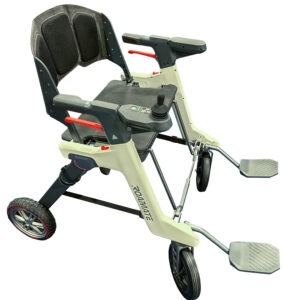
Besides being lightweight and easy to transport, the Roamate’s 3.3–pound battery offers 12.5 miles per charge and takes just three hours to recharge. Rich says the battery provided more than enough power for him to travel around the sites and memorials in Washington, D.C., during an Honor Flight trip last year. Additionally, the Roamate offers other features that might be surprising to find on such a device, including:
- Smart AI hill control: Onboard AI detects the terrain and automatically adds power going uphill or resistance going downhill.
- Robotic-grade power: Two 240-watt motors deliver enough power to handle 10-degree inclines and off-road terrain.
- Precision control: The Roamate has a 25-inch turning radius and a .01-second response time.
A Vietnam War veteran, Rich has back issues that led him to use traditional mobility devices for years, but he found them too heavy to transport. He was one of the first people to help beta test Roamate starting last spring, and he received his current version late last year. Rich liked the device so much he was asked by the company to represent and promote it. He says the Roamate’s functionality is a big selling point for him.
“Every week, I go to the movies, I use it to go to the mall, and I’m using it to travel around CES,” Rich says. “It’s much more versatile because people who can walk some can use the rollator, but it’s a power rollator. If they’re getting tired going up a hill, they press a button and the motor provides assistance.”
As of press time, the Roamate is available for $2,499 through the company’s website. For more information, visit myroamate.com.